Friday Night Lights: A Town, a Team, and a Dream by H. G. Bissinger is a 1990 memoir book about small-town america, race and class, identity. Odessa organized its collective identity around high school football to a degree that distorted educational priorities, racial dynamics, and the actual futures of the players.
Summary
Friday Night Lights is H. G. Bissinger's account of the 1988 season of the Permian Panthers, a high school football team in Odessa, Texas, that he embedded with for a year. What he found was more complicated and more troubling than a sports story. Odessa had organized its entire civic identity around the performance of seventeen-year-old boys on a Friday night, and the town's racial and economic dynamics were inseparable from that obsession.
Bissinger follows the players closely — particularly Boobie Miles, a running back whose knee injury before the season begins sets in motion a personal story of rising and falling that becomes one of the book's most painful threads. He also follows the coaches, the boosters, the parents, and the school administrators who manage a program whose budget exceeds the academic department's by a significant margin. The imbalance is not incidental; it is the point.
The racial dimension is central to the book. Permian's best players were disproportionately Black, and the town's relationship to those players was deeply ambivalent — celebrated on the field, overlooked in the classroom, ignored in the business district. Bissinger documents this without turning it into polemic, letting the contradictions speak for themselves. The school's academic expectations for Black athletes are described in specific, damning detail.
When the book was published in 1990, it provoked fury in Odessa. Bissinger received death threats and the town held a book burning. The controversy itself confirmed the book's central argument: that Odessa had confused high school football with community identity to a degree that made honest scrutiny feel like an attack. Friday Night Lights has held up because it is not primarily about football. It is about what happens to a community, and to the young men at its center, when entertainment becomes purpose.
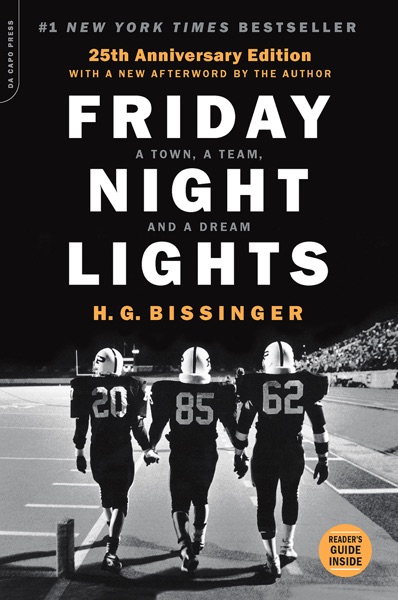
Talk to Friday Night Lights: A Town, a Team, and a Dream like its author wrote you back.
Get the ideas that fit your life — not generic summaries.
- Chat with the book
- Audiobook-style main ideas
- Adapts to your life and goals
- Helps you take action
Key takeaways
- 1.
Odessa organized its collective identity around high school football to a degree that distorted educational priorities, racial dynamics, and the actual futures of the players.
- 2.
The Permian program spent significantly more on football than on academic programs — a disparity Bissinger documents in specific budget figures.
- 3.
Black athletes were celebrated on the field and largely invisible everywhere else in Odessa's civic life.
- 4.
Boobie Miles's story — the star running back whose knee gave out — is a parable about what happens when an athlete's value is purely athletic.
- 5.
The coaches are shown as complex: not villains, but men operating within a system that measures them entirely by wins.
- 6.
The parents and boosters who fueled the program were also its most obvious victims — their identity collapsed into a team record they couldn't control.
- 7.
The book's argument is structural, not personal: the problem is not bad people but a system that created bad incentives for everyone in it.
- 8.
The town's hostile response to the book on publication was itself evidence of the pathology Bissinger described.
Discussion questions
Use these on your own, with a book club, or as chat starters in Superbook. Book club version, ready to copy or print →
- 1.
Bissinger argues that Odessa's investment in football served as a substitute for civic purpose. What does your own community use as a similar substitute?
- 2.
The Permian football program was genuinely excellent and produced real community pride. Is it possible to hold that alongside Bissinger's critique, or does his argument require choosing?
- 3.
Boobie Miles's story is the emotional center of the book for many readers. What does his trajectory say about what happens when a young man's identity becomes entirely athletic?
- 4.
The book documents that Black players were used and then discarded. How do the players themselves seem to understand their situation?
- 5.
Bissinger spent a year embedded with the team. How does that kind of access shape what a journalist can see and what they might miss?
- 6.
The coaches are shown as aware of the system's problems and trapped inside it anyway. Is that a defense or an indictment?
- 7.
When the book was published, Odessa held a book burning. What does a community's reaction to being accurately described tell you about the accuracy of the description?
- 8.
Texas high school football culture has arguably intensified since 1990. Does the book feel more or less relevant now than when it was written?
- 9.
The academic neglect of the players is documented specifically. Who was responsible, in your reading — the school, the coaches, the parents, the boosters, or the players themselves?
- 10.
Friday Night Lights eventually became a TV series that humanized many of the same dynamics. Does fiction handle this subject more fairly, or does it soften what needs to be sharp?
- 11.
What does the book say about the relationship between winning and well-being? Are the people in Odessa happier when the team wins?
- 12.
What, if anything, do you think Odessa got right about community and shared identity that larger, more diffuse places have lost?
Themes
Frequently asked questions
-
Is Friday Night Lights worth reading if you don't care about football?
Yes. The book is about race, class, small-town identity, and what a community does to young men when it decides their only value is athletic. Football is the vehicle; the subject is American culture.
-
How accurate is the TV show to the book?
The show took the setting and spirit but created entirely fictional characters and storylines. It is a separate work that happens to share a world. The book is considerably darker and more politically specific than the series.
-
What happened to the players after the 1988 season?
Bissinger followed up with many of them years later. The outcomes were largely as the book's argument would predict: few played college or professional football, and the students with academic options did better than those without. Later editions include updates.
-
Why did Odessa burn the book?
The book's portrayal of the town's racial dynamics, its academic neglect of athletes, and its institutional obsession with winning enraged residents who felt Bissinger had misrepresented them. Bissinger received death threats.
-
How long is Friday Night Lights?
Around six to seven hours at average reading pace. It reads faster than many books of similar length because the narrative momentum is strong once the season begins.
Similar books
Moneyball: The Art of Winning an Unfair Game
Michael Lewis
The Boys in the Boat: Nine Americans and Their Epic Quest for Gold at the 1936 Berlin Olympics
Daniel James Brown
Open: An Autobiography
Andre Agassi

Can't Hurt Me
David Goggins
