Talk to Genius Makers like its author wrote you back.
Get the ideas that fit your life — not generic summaries.
- Chat with the book
- Audiobook-style main ideas
- Adapts to your life and goals
- Helps you take action
What it argues
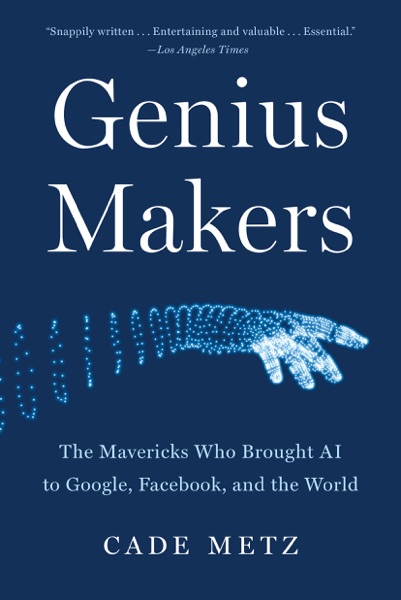
Genius Makers is New York Times technology reporter Cade Metz's account of the people who built modern artificial intelligence — primarily the deep learning revolution that ran from roughly 2009 to 2020. The book centers on Geoffrey Hinton, Yoshua Bengio, and Yann LeCun, the researchers who spent decades arguing for neural networks when the field's mainstream had abandoned them, and then watched their approach remake first computer vision, then speech recognition, then language. It also gives extended attention to the corporate race that followed: the competition between Google, DeepMind, Facebook, and OpenAI for the researchers, compute, and strategic advantage that AI suddenly represented.
The narrative method is reporting rather than analysis. Metz had access to many of the principals, and the book is richest in scene-level detail — the hiring wars, the lab cultures, the internal debates about safety and speed, the moment when Google paid $650 million for a London AI lab most people had never heard of. The result is a readable account of who made what decisions and why, though it prioritizes the drama of the people over the technical substance of the ideas.
What it gets right
- 1.
Deep learning's success came after decades of neglect. Hinton, LeCun, and Bengio kept working on neural networks through years when mainstream AI research had moved to other approaches.
- 2.
The ImageNet competition in 2012 was the public inflection point: a deep learning model from Hinton's lab crushed the existing state of the art in image recognition, and the race was on.
- 3.
Google's acquisition of DeepMind in 2014 was driven less by specific products than by fear of falling behind in a race that was suddenly legible to the industry's leadership.
What it covers
Who wrote it
Cade Metz is a technology journalist at The New York Times, where he covers artificial intelligence, self-driving cars, and Silicon Valley. Before joining the Times he wrote for Wired and The Register. He spent several years reporting on the deep learning revolution while it was happening, which gave him access to many of the principal researchers and executives featured in Genius Makers. He is based in San Francisco.
