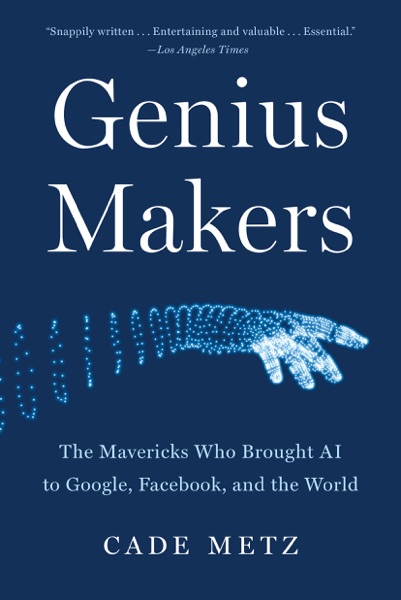
Genius Makers by Cade Metz is a 2021 biography book about artificial intelligence, tech industry competition, scientific ambition. Deep learning's success came after decades of neglect. Hinton, LeCun, and Bengio kept working on neural networks through years when mainstream AI research had moved to other approaches.
Summary
Genius Makers is New York Times technology reporter Cade Metz's account of the people who built modern artificial intelligence — primarily the deep learning revolution that ran from roughly 2009 to 2020. The book centers on Geoffrey Hinton, Yoshua Bengio, and Yann LeCun, the researchers who spent decades arguing for neural networks when the field's mainstream had abandoned them, and then watched their approach remake first computer vision, then speech recognition, then language. It also gives extended attention to the corporate race that followed: the competition between Google, DeepMind, Facebook, and OpenAI for the researchers, compute, and strategic advantage that AI suddenly represented.
The narrative method is reporting rather than analysis. Metz had access to many of the principals, and the book is richest in scene-level detail — the hiring wars, the lab cultures, the internal debates about safety and speed, the moment when Google paid $650 million for a London AI lab most people had never heard of. The result is a readable account of who made what decisions and why, though it prioritizes the drama of the people over the technical substance of the ideas.
The ethical questions run through the book without quite dominating it. OpenAI's founding premise was that if transformative AI was coming, it was better to have safety-oriented researchers at the frontier than to cede the ground to pure commercial labs. The tension between that premise and OpenAI's subsequent behavior — closing its research, competing commercially, pursuing massive compute advantages — is one of the book's recurring themes. Metz is a good enough reporter to show the gap between stated values and actual choices without making the narrative a polemic.
Genius Makers works best as a cast-of-characters account of a pivotal decade. For readers who want to understand not just what AI is but how it got here and who drove it, the book fills a genuine gap. The technical picture is surface-level, and readers looking for depth on the actual science will need to supplement it. But as industrial history — the sociology of a technology transition — it is reliable and well-paced.
Talk to Genius Makers like its author wrote you back.
Get the ideas that fit your life — not generic summaries.
- Chat with the book
- Audiobook-style main ideas
- Adapts to your life and goals
- Helps you take action
Key takeaways
- 1.
Deep learning's success came after decades of neglect. Hinton, LeCun, and Bengio kept working on neural networks through years when mainstream AI research had moved to other approaches.
- 2.
The ImageNet competition in 2012 was the public inflection point: a deep learning model from Hinton's lab crushed the existing state of the art in image recognition, and the race was on.
- 3.
Google's acquisition of DeepMind in 2014 was driven less by specific products than by fear of falling behind in a race that was suddenly legible to the industry's leadership.
- 4.
OpenAI was founded on the premise that safety-oriented researchers should be at the frontier of AI development — but its subsequent choices around commercialization and research secrecy complicated that narrative.
- 5.
The hiring market for AI researchers became one of the most competitive in any technical field. Salaries at frontier labs reached levels previously confined to finance.
- 6.
Compute, not just algorithms, drove the deep learning revolution. The availability of cheap GPUs for training large neural networks unlocked capabilities that had been theoretically possible for years.
- 7.
Ethical concerns about AI bias, surveillance applications, and military use created real internal tensions at Google, DeepMind, and other labs — though Metz shows that commercial and strategic pressures consistently won.
- 8.
The concentration of frontier AI in a handful of American and Chinese institutions creates structural risks that individual researchers and even lab leaders have limited ability to address.
Discussion questions
Use these on your own, with a book club, or as chat starters in Superbook. Book club version, ready to copy or print →
- 1.
The book portrays Hinton, Bengio, and LeCun as researchers who held a minority view for decades and were eventually vindicated. What does this suggest about how scientific communities evaluate heterodox ideas?
- 2.
OpenAI's founding premise was that safety-focused researchers should lead the frontier. By the time of the book's publication, that premise was already under strain. What went wrong?
- 3.
Several researchers in the book express genuine concern about the systems they're building while continuing to build them. How do you read that — as cognitive dissonance, or as a rational response to a collective action problem?
- 4.
Google's acquisition of DeepMind removed a potentially independent research institution from the landscape. What might a world look like where frontier AI research stayed outside of big tech?
- 5.
The book describes an arms race between Google, Facebook, and OpenAI that drove both acceleration and risk. What structural changes would be needed to slow that race without conceding ground to less safety-conscious actors?
- 6.
Metz shows that concerns about AI bias and military applications were raised internally at multiple labs and repeatedly overridden. Who or what has the leverage to change that pattern?
- 7.
The 'genius makers' of the title are overwhelmingly male and mostly from a handful of elite universities. What does the demographic homogeneity of the field tell us about how it developed?
- 8.
The book ends in roughly 2020. How much has the picture changed since then — and does it change the moral of Metz's story?
- 9.
Hinton later became one of AI's most prominent public critics. Does his earlier role as a core builder of the technology affect how you weigh his warnings?
- 10.
The compute threshold for competitive AI research has made it effectively impossible for academic labs to keep pace with corporate ones. What are the consequences of that shift for the field?
- 11.
Metz is a reporter, not a technologist. Do you think that shapes what the book gets right and what it gets wrong?
- 12.
If you were advising a young researcher deciding between an academic career and a frontier AI lab, what would you tell them — and what does the book tell you about that choice?
Themes
Frequently asked questions
-
What is Genius Makers about?
It tells the story of the deep learning revolution in AI through the people who built it — primarily Geoffrey Hinton, Yann LeCun, and Yoshua Bengio — and the corporate competition between Google, DeepMind, Facebook, and OpenAI that followed once AI became commercially valuable.
-
How technical is Genius Makers?
Not very. It's journalism rather than engineering. Metz explains enough to follow the narrative but doesn't go deep on how neural networks actually work. Readers looking for technical depth will need a different book; readers who want the human and organizational story of how AI got here will find this useful.
-
Is Genius Makers worth reading in 2026?
Yes, as historical context. The events it covers — the 2012 ImageNet moment, the founding of OpenAI, Google's DeepMind acquisition — are now foundational to understanding the current AI landscape. The book ends before GPT-3 or ChatGPT, so it's incomplete, but it's a solid account of the preceding decade.
-
Who should read Genius Makers?
People who want to understand the human and institutional story behind modern AI, rather than the technical or philosophical dimensions. It's particularly useful for anyone working in tech who wants context for why the major players are positioned the way they are.
-
How does Genius Makers compare to The Coming Wave?
They complement each other. Genius Makers is history and character study — how we got here. The Coming Wave is forward-looking and policy-focused — where we might be going and what should be done about it. Read together they provide good coverage of both the industrial history and the governance challenge.
Similar books
The Innovators: How a Group of Hackers, Geniuses, and Geeks Created the Digital Revolution
Walter Isaacson
Life 3.0: Being Human in the Age of Artificial Intelligence
Max Tegmark
Superintelligence: Paths, Dangers, Strategies
Nick Bostrom
AI Superpowers
Kai-Fu Lee
