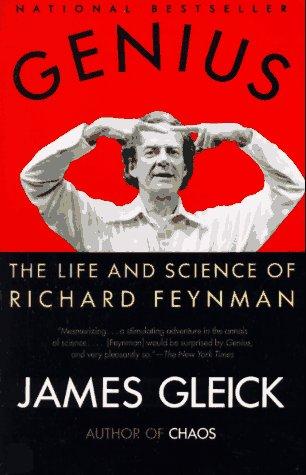
Talk to Genius: The Life and Science of Richard Feynman like its author wrote you back.
Get the ideas that fit your life — not generic summaries.
- Chat with the book
- Audiobook-style main ideas
- Adapts to your life and goals
- Helps you take action
What it argues
Genius is James Gleick's biography of Richard Feynman, the Nobel Prize-winning physicist who developed quantum electrodynamics, cracked safes at Los Alamos, played bongo drums in bars, and became the twentieth century's most celebrated scientific personality. The book traces Feynman from his Queens childhood — his father a uniform manufacturer with deep scientific curiosity — through his graduate work under John Archibald Wheeler at Princeton, his crucial contribution to the Manhattan Project, his long career at Caltech, and his public reckoning with the Challenger disaster in the year before his death in 1988.
Gleick is unusually well-positioned to tell this story. He had access to unpublished letters, notebooks, and interviews, and his Chaos had already demonstrated his ability to make difficult physics accessible. The scientific sections of Genius are among the best popularizations of quantum electrodynamics ever written. QED — the quantum theory of how light and matter interact — was the problem of mid-twentieth-century physics, and Feynman's path integral formulation, along with the diagrams now called Feynman diagrams, gave physicists a new computational and conceptual tool of extraordinary power.
What it gets right
- 1.
Feynman's path integral formulation of quantum mechanics — calculating the probability of a particle's trajectory by summing over all possible paths — provided both a new computational tool and a new way of thinking about quantum behavior.
- 2.
Feynman diagrams replaced the abstract equations of quantum field theory with a visual calculus; physicists still use them routinely today to calculate particle interaction probabilities.
- 3.
Feynman's approach to physics was fundamentally physical and intuitive — he wanted to see what the equations were describing, not just compute the right numbers.
What it covers
Who wrote it
James Gleick is an American author and journalist who has written extensively about science and technology. His books include Chaos: Making a New Science, The Information: A History, a Theory, a Flood, and Time Travel: A History. Gleick co-founded one of the early internet service providers and has written for The New York Times. Genius was a finalist for the Pulitzer Prize in Biography in 1993. His work is distinguished by its ability to make difficult scientific ideas accessible through narrative without sacrificing accuracy.
