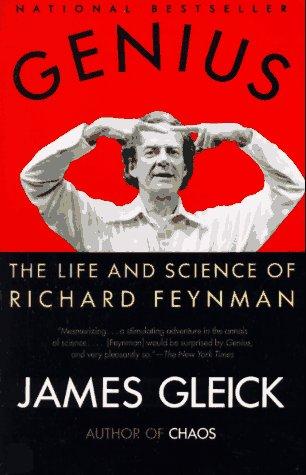
Genius: The Life and Science of Richard Feynman by James Gleick is a 1992 biography book about physics, scientific genius, quantum electrodynamics. Feynman's path integral formulation of quantum mechanics — calculating the probability of a particle's trajectory by summing over all possible paths — provided both a new computational tool and a new way of thinking about quantum behavior.
Summary
Genius is James Gleick's biography of Richard Feynman, the Nobel Prize-winning physicist who developed quantum electrodynamics, cracked safes at Los Alamos, played bongo drums in bars, and became the twentieth century's most celebrated scientific personality. The book traces Feynman from his Queens childhood — his father a uniform manufacturer with deep scientific curiosity — through his graduate work under John Archibald Wheeler at Princeton, his crucial contribution to the Manhattan Project, his long career at Caltech, and his public reckoning with the Challenger disaster in the year before his death in 1988.
Gleick is unusually well-positioned to tell this story. He had access to unpublished letters, notebooks, and interviews, and his Chaos had already demonstrated his ability to make difficult physics accessible. The scientific sections of Genius are among the best popularizations of quantum electrodynamics ever written. QED — the quantum theory of how light and matter interact — was the problem of mid-twentieth-century physics, and Feynman's path integral formulation, along with the diagrams now called Feynman diagrams, gave physicists a new computational and conceptual tool of extraordinary power.
But Gleick is equally interested in Feynman as a type: the American pragmatist genius, allergic to abstraction and authority, who preferred working from first principles to citing established results. Feynman famously claimed not to have read most of the physics literature before solving problems, a claim that Gleick treats skeptically but uses to illuminate Feynman's genuinely unusual cognitive style. The book also deals honestly with Feynman's relationship with women — his charm, his serial womanizing, his first wife Arline's death from tuberculosis while he was at Los Alamos, and passages in his own writings that later generations have found difficult.
The result is a portrait of a particular kind of scientific mind: playful, concrete, physically intuitive, contemptuous of pretension, and capable of seeing through mathematical formalism to the underlying physical picture. Whether or not Feynman deserves the "greatest physicist of his generation" label sometimes applied to him, Gleick makes the case that he was genuinely singular.
Talk to Genius: The Life and Science of Richard Feynman like its author wrote you back.
Get the ideas that fit your life — not generic summaries.
- Chat with the book
- Audiobook-style main ideas
- Adapts to your life and goals
- Helps you take action
Key takeaways
- 1.
Feynman's path integral formulation of quantum mechanics — calculating the probability of a particle's trajectory by summing over all possible paths — provided both a new computational tool and a new way of thinking about quantum behavior.
- 2.
Feynman diagrams replaced the abstract equations of quantum field theory with a visual calculus; physicists still use them routinely today to calculate particle interaction probabilities.
- 3.
Feynman's approach to physics was fundamentally physical and intuitive — he wanted to see what the equations were describing, not just compute the right numbers.
- 4.
His work at Los Alamos on the Manhattan Project showed his gift for practical problem-solving under pressure, but also marked him with a lifelong ambivalence about the bomb.
- 5.
His famous Challenger O-ring demonstration — dipping a piece of rubber in ice water before cameras during the official investigation — exemplified his contempt for institutional evasion.
- 6.
Feynman's public persona — the bongo-playing, safecracking, irreverent Nobelist — was partly real and partly carefully cultivated; both aspects served to distinguish him from what he saw as the pomposity of academic physics.
- 7.
The Nobel Prize he shared in 1965 for QED was shared with Julian Schwinger and Sin-Itiro Tomonaga, who had developed equivalent formulations independently. The physics community chose Feynman's approach as its working tool.
- 8.
Gleick argues that Feynman's genius was not just intelligence but a specific mode of learning and problem-solving: deriving things from scratch, distrusting received authority, working by physical analogy.
Discussion questions
Use these on your own, with a book club, or as chat starters in Superbook. Book club version, ready to copy or print →
- 1.
Gleick suggests Feynman's genius lay partly in his refusal to simply accept established results. Is that skeptical approach universally useful or only valuable in certain scientific contexts?
- 2.
Feynman worked through graduate school at MIT and then Princeton during the Depression. How does historical context — the Depression, World War II, the Cold War — shape the science in this book?
- 3.
How do you evaluate Feynman's relationship with women as Gleick describes it? Does separating the science from the person seem possible or necessary?
- 4.
His father gave him a deep love of inquiry and his own way of seeing the world. What does that relationship suggest about how scientific curiosity is formed?
- 5.
Feynman claimed he learned best by deriving things himself rather than reading others' work. Is that a replicable learning strategy or a feature of an unusual mind?
- 6.
The Challenger investigation made Feynman famous to a new generation as someone willing to challenge NASA bureaucracy. How do institutional pressures typically distort expert judgment?
- 7.
Feynman won the Nobel Prize for work done in his mid-twenties. Did his later career match the promise of that early work, or is there a pattern of declining productivity after early genius?
- 8.
The book covers Feynman diagrams in some detail. Before reading, had you encountered them? What makes a scientific tool like that genuinely useful?
- 9.
Gleick distinguishes Feynman from Julian Schwinger, who developed an equivalent but more abstract formalism. What decided which approach physicists adopted?
- 10.
Feynman was famously skeptical of philosophy and of using words rather than mathematics to describe physics. Is that skepticism justified or limiting?
- 11.
Several of Feynman's own books — including Surely You're Joking, Mr. Feynman! — are also widely read. How does the biography differ in its portrait from the self-portrait?
- 12.
What does Gleick seem to admire most about Feynman, and what does he seem to find troubling?
Themes
Frequently asked questions
-
Do I need to understand physics to read Genius?
No. Gleick explains Feynman's physics clearly, including quantum electrodynamics, without assuming prior knowledge. The scientific sections are accessible to motivated general readers. The biography works as a human story even for readers who skip the technical detail.
-
How does Genius compare to Feynman's own books?
Feynman's own memoirs — particularly Surely You're Joking, Mr. Feynman! — are funnier and more vivid but less complete. Gleick gives more context, covers the science more thoroughly, and is more willing to be critical. Both are worth reading; they complement rather than duplicate each other.
-
What is quantum electrodynamics?
QED is the quantum theory of how light and matter interact — how electrons emit and absorb photons. It is the most precisely tested theory in all of physics: its predictions match experimental measurements to better than one part in a billion. Feynman's path integral approach and his diagrams made it practical to compute with.
-
Is Feynman overrated?
That debate is real among physicists. Gleick acknowledges that some of the 'greatest physicist of his generation' claims are inflated. But the technical contributions — path integrals, QED, Feynman diagrams — are genuinely foundational. The celebrity physicist persona sometimes overshadows the actual physics.
-
What is the most memorable scene in the book?
Probably Feynman's O-ring demonstration during the Challenger investigation — dropping a rubber ring into ice water and showing it lost elasticity at low temperature, directly contradicting NASA's safety narrative. It captured his contempt for institutional evasion and his gift for physical demonstration.
Similar books
Surely You're Joking, Mr. Feynman!
Richard P. Feynman
Chaos: Making a New Science
James Gleick
The Information: A History, a Theory, a Flood
James Gleick
The Double Helix
James D. Watson
