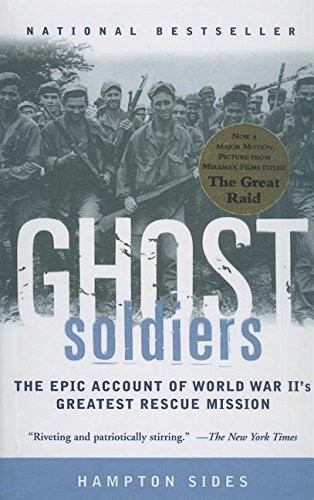
Talk to Ghost Soldiers: The Forgotten Epic Story of World War II's Most Dramatic Mission like its author wrote you back.
Get the ideas that fit your life — not generic summaries.
- Chat with the book
- Audiobook-style main ideas
- Adapts to your life and goals
- Helps you take action
What it argues
Ghost Soldiers tells the story of the January 1945 raid on the Cabanatuan prisoner-of-war camp in the Philippines — a mission to rescue 513 American and Allied prisoners, survivors of the Bataan Death March, before the retreating Japanese army could execute them. Hampton Sides structures the narrative in two interlocking threads: the three-year ordeal of the prisoners inside the camp, and the 100-mile behind-enemy-lines march of the Alamo Scouts and 6th Ranger Battalion to reach them.
The prisoners' story is brutal. Sides documents the starvation, disease, torture, and systematic degradation of the Bataan survivors with unflinching specificity. These men had endured the Death March, then years of captivity marked by arbitrary violence and calculated starvation. By January 1945, intelligence indicated that the Japanese had massacred prisoners at a camp on Palawan rather than let them be liberated. The men at Cabanatuan had reason to believe the same fate awaited them.
What it gets right
- 1.
The Cabanatuan raid succeeded because of years of patient intelligence-gathering by Filipino civilians and guerrillas, without whom the rangers would have had no reliable picture of the camp.
- 2.
The Bataan Death March killed thousands through deliberate cruelty and neglect. The survivors who reached Cabanatuan had already outlasted conditions designed to break or kill them.
- 3.
The Palawan massacre — where Japanese guards burned and shot prisoners rather than allow their liberation — was not an isolated atrocity. It was a policy that the Cabanatuan prisoners had every reason to expect would be applied to them.
What it covers
Who wrote it
Hampton Sides is an American journalist and narrative historian whose work focuses on exploration, military history, and the American West. He is a contributing editor at Outside magazine and the author of In the Kingdom of Ice, Blood and Thunder, and Hellhound on His Trail, among other books. Ghost Soldiers, published in 2001, became a bestseller and was adapted into the film The Great Raid. Sides is known for combining meticulous archival research with the narrative momentum of literary nonfiction.
