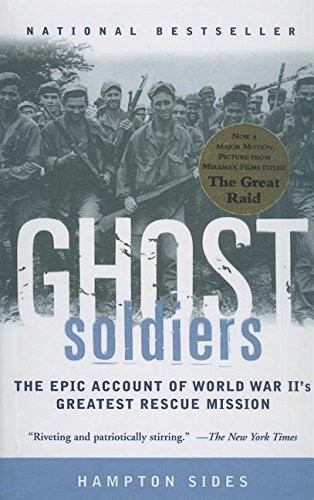
Ghost Soldiers: The Forgotten Epic Story of World War II's Most Dramatic Mission by Hampton Sides is a 2001 history book about war, survival, leadership. The Cabanatuan raid succeeded because of years of patient intelligence-gathering by Filipino civilians and guerrillas, without whom the rangers would have had no reliable picture of the camp.
Summary
Ghost Soldiers tells the story of the January 1945 raid on the Cabanatuan prisoner-of-war camp in the Philippines — a mission to rescue 513 American and Allied prisoners, survivors of the Bataan Death March, before the retreating Japanese army could execute them. Hampton Sides structures the narrative in two interlocking threads: the three-year ordeal of the prisoners inside the camp, and the 100-mile behind-enemy-lines march of the Alamo Scouts and 6th Ranger Battalion to reach them.
The prisoners' story is brutal. Sides documents the starvation, disease, torture, and systematic degradation of the Bataan survivors with unflinching specificity. These men had endured the Death March, then years of captivity marked by arbitrary violence and calculated starvation. By January 1945, intelligence indicated that the Japanese had massacred prisoners at a camp on Palawan rather than let them be liberated. The men at Cabanatuan had reason to believe the same fate awaited them.
The raid itself — ninety minutes from start to finish — is reconstructed from multiple firsthand accounts, Filipino guerrilla testimony, and military records. Sides captures the extraordinary coordination required: rangers, scouts, Filipino civilians, and guerrilla forces operating behind Japanese lines, relying on surprise and speed, with no margin for error. The rescue worked because the planning was meticulous, the intelligence was good, and the local Filipino population risked everything to help.
What elevates Ghost Soldiers above a straightforward military history is Sides' attention to the humanity of both the prisoners and the rescuers. He doesn't treat the raid as a clean victory divorced from context. The Philippines civilian population suffered enormously. The command decisions that led to Bataan were controversial. And many of the rescued men were so damaged that survival was not the same as recovery. Sides holds all of this without losing the narrative momentum.
Talk to Ghost Soldiers: The Forgotten Epic Story of World War II's Most Dramatic Mission like its author wrote you back.
Get the ideas that fit your life — not generic summaries.
- Chat with the book
- Audiobook-style main ideas
- Adapts to your life and goals
- Helps you take action
Key takeaways
- 1.
The Cabanatuan raid succeeded because of years of patient intelligence-gathering by Filipino civilians and guerrillas, without whom the rangers would have had no reliable picture of the camp.
- 2.
The Bataan Death March killed thousands through deliberate cruelty and neglect. The survivors who reached Cabanatuan had already outlasted conditions designed to break or kill them.
- 3.
The Palawan massacre — where Japanese guards burned and shot prisoners rather than allow their liberation — was not an isolated atrocity. It was a policy that the Cabanatuan prisoners had every reason to expect would be applied to them.
- 4.
Military rescue missions at the scale of Cabanatuan require months of preparation for ninety minutes of action. The ratio of planning to execution is rarely honored in popular accounts of special operations.
- 5.
Filipino guerrilla resistance was extensive, organized, and strategically crucial to the American campaign to retake the Philippines — a contribution that postwar American memory largely erased.
- 6.
Many of the rescued prisoners were so physically destroyed that they died in the weeks after liberation. Survival of the camp did not mean survival of its effects.
- 7.
The command culture that made Bataan possible — bureaucratic delay, interservice rivalry, unrealistic optimism about Japanese intentions — was recognizable to the men who lived through it.
- 8.
Sides argues that the Cabanatuan raid was one of the most successful special operations missions in American military history, and that its obscurity reflects a broader failure to integrate special operations into how the public understands the war.
Discussion questions
Use these on your own, with a book club, or as chat starters in Superbook. Book club version, ready to copy or print →
- 1.
The prisoners developed elaborate social structures and moral codes inside the camp. What do you think those structures preserved, and what did they cost the men who lived under them?
- 2.
Filipino civilians took enormous risks to help American prisoners and the rescue mission. How should we weigh their contribution against the way postwar narratives — and the book's title — center American soldiers?
- 3.
The decision to launch the raid was made on limited intelligence and with significant uncertainty. How do military commanders — or any leader — decide when imperfect information is enough to act?
- 4.
Sides reconstructs individual experiences of the Death March in detail. What ethical obligations does a writer have when reconstructing atrocities from survivors' testimony?
- 5.
The Palawan massacre was a major factor in the decision to raid Cabanatuan. How does the prospect of imminent execution change the calculation of risk for a rescue mission?
- 6.
Many of the rescued men were too damaged to recover fully. Does that change how you read the raid — as rescue or as survival of a different kind of ordeal?
- 7.
The rangers and scouts operated with near-total surprise and minimal casualties. When does military success depend on luck rather than skill, and how do we tell the difference in retrospect?
- 8.
Sides notes that the Cabanatuan raid is barely remembered in popular accounts of World War II. Why do you think some military operations become cultural touchstones while others are forgotten?
- 9.
The book traces institutional failures that led to Bataan — bureaucratic delay, inadequate supply, political miscalculation. How do organizational failures and individual heroism coexist in the same event?
- 10.
Have you read other accounts of prisoner-of-war experience? How does the Cabanatuan story compare, and what does it add to your understanding of captivity as a specific form of war?
- 11.
Sides ends with what happened to the survivors after the war. What does that epilogue add to the book's argument, and what does it say about how we talk about trauma and recovery?
- 12.
If this mission had failed, it likely would have been remembered as a reckless gamble. Success defined it as heroism. How should we evaluate decisions that could have gone either way?
Themes
Frequently asked questions
-
Is Ghost Soldiers worth reading?
Yes. It is one of the most gripping accounts of World War II rescue operations in print. Sides manages both the intimate prisoner experience and the military logistics of the raid without losing either thread. If you found Unbroken compelling, Ghost Soldiers covers different ground with comparable craft.
-
How long does it take to read Ghost Soldiers?
Around six to seven hours at average reading pace. The dual narrative structure — prisoners and rescuers — keeps the pacing tense throughout, and the final third, covering the raid itself, reads very quickly.
-
What is Ghost Soldiers about?
The January 1945 rescue of 513 American and Allied prisoners from the Cabanatuan camp in the Philippines, carried out by Army Rangers and Filipino guerrillas. The book also documents the three-year ordeal of the prisoners, survivors of the Bataan Death March.
-
Who should read Ghost Soldiers?
Readers interested in World War II Pacific theater history, special operations, prisoner-of-war experience, or Philippine resistance history. It also works well for anyone who enjoys narrative nonfiction with high stakes and clear moral weight.
-
What makes this raid historically significant?
It was one of the most successful special operations missions in American military history, conducted deep behind Japanese lines with near-total surprise. It also prevented the almost certain execution of the prisoners, which intelligence indicated was imminent based on the Palawan massacre weeks earlier.
Similar books
Unbroken: A World War II Story of Survival, Resilience, and Redemption
Laura Hillenbrand
Endurance: Shackleton's Incredible Voyage
Alfred Lansing
Killers of the Flower Moon
David Grann
The Warmth of Other Suns
Isabel Wilkerson
