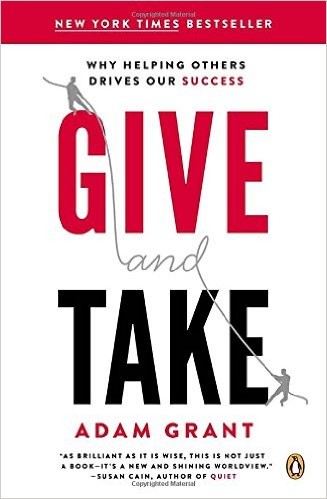
Talk to Give and Take: Why Helping Others Drives Our Success like its author wrote you back.
Get the ideas that fit your life — not generic summaries.
- Chat with the book
- Audiobook-style main ideas
- Adapts to your life and goals
- Helps you take action
Give and Take: Why Helping Others Drives Our Success, in detail
Give and Take is Adam Grant's argument that the least intuitive kind of person — the giver, who helps others without expecting immediate return — actually ends up at the top of most social and professional hierarchies, not just the bottom. The surface-level version of this claim sounds like optimistic self-help, but Grant's case is more careful: he distinguishes between two types of givers, identifies why unsuccessful ones burn out, and explains what separates the doormat from the genuinely effective altruist.
Grant categorizes people into three styles: givers (who contribute more than they take), takers (who try to get as much as possible), and matchers (who balance giving and getting). His research shows that givers appear at both the bottom and the top of most outcomes. The givers at the bottom are the ones who help indiscriminately at the expense of their own priorities. The givers at the top are "otherish" — genuinely motivated by helping but strategic enough to protect their time and direct their giving where it creates the most value.
The book is richest in its chapters on organizational dynamics. Grant shows how a single taker in a team can produce a cascade of defensive self-interest throughout the group, while a giver can do the opposite: elevating everyone around them. He also examines the five-minute favor — small acts of help that cost little but mean a lot to the recipient — and the power of asking for help, which creates reciprocity and connection rather than signaling weakness.
Where Give and Take sometimes overreaches is in the causation it implies. The correlation between generous behavior and career success is real in the data, but the mechanism is messier than the clean typology suggests. Most people are context-dependent rather than stably giver or taker across all settings. Still, the book's central insight holds: building a reputation for genuine contribution changes what you get access to, who brings you opportunities, and who advocates for you when you're not in the room.
The big ideas
- 1.
Givers, matchers, and takers coexist in every workplace. Givers outperform over the long run but also underperform in the short run — the distribution is bimodal, not linear.
- 2.
The givers who burn out help indiscriminately. Effective givers — 'otherish' ones — are genuinely motivated by others but protect their time and direct help where it has highest impact.
- 3.
Takers are remarkably hard to identify in one-on-one interactions; they often act like givers when they need something. The tell is how they treat people with no power over them.
