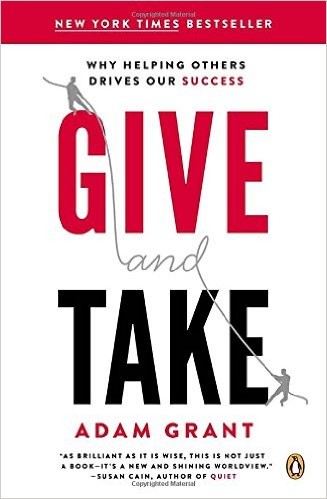
Give and Take: Why Helping Others Drives Our Success by Adam Grant is a 2013 psychology book about generosity, reciprocity, success. Givers, matchers, and takers coexist in every workplace. Givers outperform over the long run but also underperform in the short run — the distribution is bimodal, not linear.
Summary
Give and Take is Adam Grant's argument that the least intuitive kind of person — the giver, who helps others without expecting immediate return — actually ends up at the top of most social and professional hierarchies, not just the bottom. The surface-level version of this claim sounds like optimistic self-help, but Grant's case is more careful: he distinguishes between two types of givers, identifies why unsuccessful ones burn out, and explains what separates the doormat from the genuinely effective altruist.
Grant categorizes people into three styles: givers (who contribute more than they take), takers (who try to get as much as possible), and matchers (who balance giving and getting). His research shows that givers appear at both the bottom and the top of most outcomes. The givers at the bottom are the ones who help indiscriminately at the expense of their own priorities. The givers at the top are "otherish" — genuinely motivated by helping but strategic enough to protect their time and direct their giving where it creates the most value.
The book is richest in its chapters on organizational dynamics. Grant shows how a single taker in a team can produce a cascade of defensive self-interest throughout the group, while a giver can do the opposite: elevating everyone around them. He also examines the five-minute favor — small acts of help that cost little but mean a lot to the recipient — and the power of asking for help, which creates reciprocity and connection rather than signaling weakness.
Where Give and Take sometimes overreaches is in the causation it implies. The correlation between generous behavior and career success is real in the data, but the mechanism is messier than the clean typology suggests. Most people are context-dependent rather than stably giver or taker across all settings. Still, the book's central insight holds: building a reputation for genuine contribution changes what you get access to, who brings you opportunities, and who advocates for you when you're not in the room.
Talk to Give and Take: Why Helping Others Drives Our Success like its author wrote you back.
Get the ideas that fit your life — not generic summaries.
- Chat with the book
- Audiobook-style main ideas
- Adapts to your life and goals
- Helps you take action
Key takeaways
- 1.
Givers, matchers, and takers coexist in every workplace. Givers outperform over the long run but also underperform in the short run — the distribution is bimodal, not linear.
- 2.
The givers who burn out help indiscriminately. Effective givers — 'otherish' ones — are genuinely motivated by others but protect their time and direct help where it has highest impact.
- 3.
Takers are remarkably hard to identify in one-on-one interactions; they often act like givers when they need something. The tell is how they treat people with no power over them.
- 4.
A single taker in a team creates a culture of self-protection; a single giver can shift norms toward collaboration. The social influence runs asymmetrically.
- 5.
The five-minute favor — something small that costs you little but matters a lot to the recipient — is disproportionately powerful because it creates genuine reciprocity without significant time cost.
- 6.
Asking for advice and help, rather than signaling weakness, creates connection. People feel invested in you when they've helped you, and they're more likely to advocate for your success.
- 7.
Reputation for generosity compounds over time in ways that are hard to reverse-engineer. The network effects of being known as someone who helps are cumulative and often invisible until they aren't.
- 8.
Matchers enforce norms. They punish takers and reward givers more reliably than the direct parties do, which is why giving behavior often pays even when the direct recipient doesn't reciprocate.
Discussion questions
Use these on your own, with a book club, or as chat starters in Superbook. Book club version, ready to copy or print →
- 1.
Grant's typology divides people into givers, matchers, and takers. Which do you default to at work? Does that change in personal relationships?
- 2.
The burnout givers and the successful givers both help generously. What distinguishes them in practice?
- 3.
Think of someone you've worked with who was a taker. How did it affect the behavior of people around them?
- 4.
Grant argues that asking for advice creates reciprocity and connection. Is there a current situation where asking for help more explicitly might serve you better than trying to figure it out alone?
- 5.
The five-minute favor — small, low-cost help — is described as disproportionately powerful. What's the equivalent in your professional or personal context?
- 6.
The book claims givers at the bottom of outcomes fail because they give too broadly. Where in your life might selective generosity serve both you and others better than indiscriminate helping?
- 7.
Have you ever experienced the compounding network effect Grant describes — a reputation for generosity opening doors you didn't expect? What generated it?
- 8.
Grant says matchers enforce social norms by punishing takers. Do you see that operating in organizations or communities you're part of?
- 9.
Takers often look like givers in one-on-one interactions. How do you identify them more reliably? What signals do they send when they feel they have nothing to gain?
- 10.
Is there a relationship in your life where you're consistently acting as a matcher because you don't trust the other person? What would change if you shifted?
- 11.
Grant suggests that vulnerability — sharing your needs and struggles — makes you more likely to receive help than projecting competence. Does that hold in your experience?
- 12.
The research shows that givers end up both at the top and the bottom of outcomes. What does it take for a giver to move from the bottom cluster to the top?
Themes
Frequently asked questions
-
What is Give and Take about?
It argues that generosity — helping others without immediate expectation of return — is a more effective long-term career and life strategy than most people assume. Grant distinguishes between types of givers and explains why the most successful ones aren't selfless martyrs but people who give strategically while protecting their own priorities.
-
Is Give and Take worth reading?
Yes, especially if you work in a profession built on relationships, reputation, and referrals. The research is solid and the case studies are memorable. Some readers find the typology too clean and the optimism about givers occasionally strained, but the core argument holds up and is well-evidenced.
-
Who should read Give and Take?
People early in their careers who are trying to understand how professional reputations are built, managers who want to shape team culture, and anyone who has wondered whether being genuinely helpful actually pays off or just leaves you exploited.
-
How does Give and Take relate to Adam Grant's other books?
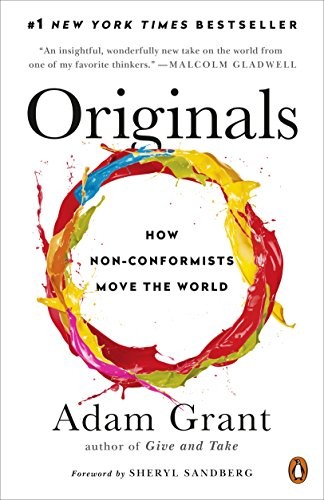
Give and Take examines generosity as a strategy. Originals examines how people champion new ideas without losing their position. Think Again examines intellectual humility. The three books share a concern with prosocial behavior and evidence-based thinking but are readable independently.
-
What is the most actionable idea in Give and Take?
The five-minute favor: identify something you can do for a contact in under five minutes that would genuinely help them. It could be an introduction, a piece of information, or a referral. The asymmetry between low cost to you and high value to them is what makes it disproportionately powerful for relationship building.
Similar books

Think Again: The Power of Knowing What You Don't Know
Adam Grant
Originals: How Non-Conformists Move the World
Adam Grant
Influence: The Psychology of Persuasion
Robert B. Cialdini
How to Win Friends and Influence People
Dale Carnegie
