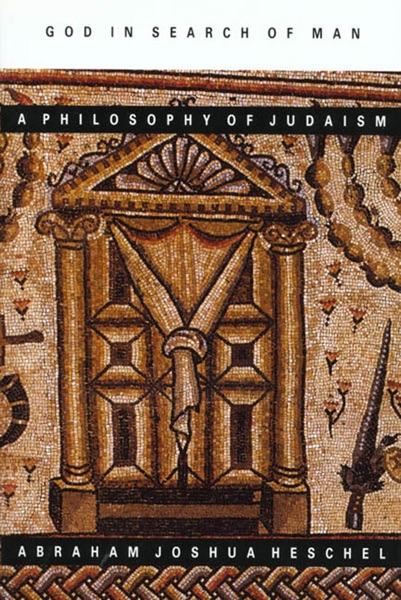
Talk to God in Search of Man: A Philosophy of Judaism like its author wrote you back.
Get the ideas that fit your life — not generic summaries.
- Chat with the book
- Audiobook-style main ideas
- Adapts to your life and goals
- Helps you take action
What it argues
God in Search of Man is Abraham Joshua Heschel's systematic philosophy of Judaism, published in 1955 as the companion to Man Is Not Alone. It is the most comprehensive statement of his religious thought and the text most often cited as his philosophical masterwork. The title reverses the usual religious framing: instead of man reaching toward God, Heschel argues that the Bible depicts God as reaching toward humanity — not because humanity is especially worthy but because that is the nature of divine concern. Revelation, on this account, is not humanity's achievement but God's initiative.
The book is organized in three parts: God, Revelation, and Response. The first part develops Heschel's concept of wonder and radical amazement — the claim that the beginning of all genuine religious life is a sense that the world is astounding, that existence itself is a question that cannot be answered by science. Heschel does not argue that this amazement proves God's existence; he argues that the person who cannot be amazed is already closed to the religious dimension of experience. The diagnostic work here is sharp: much of what passes for atheism, in his view, is not a reasoned rejection of God but a collapse of the capacity for wonder.
What it gets right
- 1.
The title expresses the book's inversion: rather than man straining toward God, the Bible depicts God as seeking relationship with humanity. Revelation is divine initiative, not human achievement.
- 2.
Radical amazement — the capacity to find existence itself startling and profound — is Heschel's starting point for religious life. Without it, no argument for God can find purchase.
- 3.
Heschel distinguishes between the event of revelation (divine, real) and the words of scripture (human, historically situated). This allows him to take both the sacred text and modern scholarship seriously.
What it covers
Who wrote it
Abraham Joshua Heschel (1907–1972) was a Polish-born Jewish philosopher and theologian who fled Nazi Germany and eventually settled in New York, where he taught at the Jewish Theological Seminary. His major works include Man Is Not Alone, God in Search of Man, The Sabbath, and The Prophets. He was deeply engaged in American public life: he marched alongside Martin Luther King Jr. in Selma in 1965 and was a vocal critic of the Vietnam War. Heschel is widely regarded as one of the 20th century's most original and searching religious thinkers, read across Jewish, Christian, and secular academic circles.
