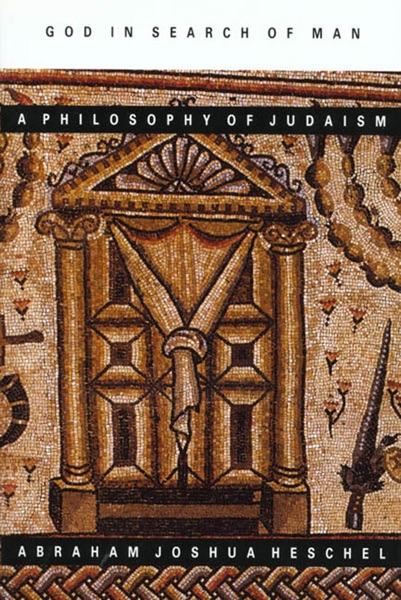
God in Search of Man: A Philosophy of Judaism by Abraham Joshua Heschel is a 1955 religion & spirituality book about religious philosophy, revelation, wonder. The title expresses the book's inversion: rather than man straining toward God, the Bible depicts God as seeking relationship with humanity. Revelation is divine initiative, not human achievement.
Summary
God in Search of Man is Abraham Joshua Heschel's systematic philosophy of Judaism, published in 1955 as the companion to Man Is Not Alone. It is the most comprehensive statement of his religious thought and the text most often cited as his philosophical masterwork. The title reverses the usual religious framing: instead of man reaching toward God, Heschel argues that the Bible depicts God as reaching toward humanity — not because humanity is especially worthy but because that is the nature of divine concern. Revelation, on this account, is not humanity's achievement but God's initiative.
The book is organized in three parts: God, Revelation, and Response. The first part develops Heschel's concept of wonder and radical amazement — the claim that the beginning of all genuine religious life is a sense that the world is astounding, that existence itself is a question that cannot be answered by science. Heschel does not argue that this amazement proves God's existence; he argues that the person who cannot be amazed is already closed to the religious dimension of experience. The diagnostic work here is sharp: much of what passes for atheism, in his view, is not a reasoned rejection of God but a collapse of the capacity for wonder.
The second part addresses revelation and Torah. Heschel distinguishes between the event of revelation — a real encounter between divine and human — and the record of revelation, which is the text of the Torah. The text is human; the event was divine. This distinction allows Heschel to take the Bible with full seriousness while acknowledging its historical embeddedness. It is a delicate position and has been criticized from both traditional and critical-scholarly directions, but it is philosophically careful.
The third part covers observance, prayer, and the meaning of mitzvoth. Heschel's argument for observance is not primarily about obedience or tradition but about the quality of attention that structured ritual can produce. Prayer is not a petition but an act of self-transformation — the attempt to stand in a relation of awareness that ordinary life forecloses. This is a demanding book, and slower than The Sabbath, but it is the fullest statement of a thinker who remained one of the most serious religious philosophers of the 20th century.
Talk to God in Search of Man: A Philosophy of Judaism like its author wrote you back.
Get the ideas that fit your life — not generic summaries.
- Chat with the book
- Audiobook-style main ideas
- Adapts to your life and goals
- Helps you take action
Key takeaways
- 1.
The title expresses the book's inversion: rather than man straining toward God, the Bible depicts God as seeking relationship with humanity. Revelation is divine initiative, not human achievement.
- 2.
Radical amazement — the capacity to find existence itself startling and profound — is Heschel's starting point for religious life. Without it, no argument for God can find purchase.
- 3.
Heschel distinguishes between the event of revelation (divine, real) and the words of scripture (human, historically situated). This allows him to take both the sacred text and modern scholarship seriously.
- 4.
Observance of mitzvoth is justified not as obedience but as a discipline of attention — a set of practices that shape the self toward awareness of what matters.
- 5.
Prayer is not asking. It is an attempt to stand in a particular quality of attention — to open the self to the divine address that Heschel believes is always occurring.
- 6.
The book diagnoses religious failure not primarily as disbelief but as insensitivity — the loss of the capacity to be moved, questioned, and astonished by experience.
- 7.
God's pathos — divine concern for the world and for humanity — is Heschel's alternative to both a remote, impersonal deity and a sentimental one. God is affected by what happens.
- 8.
Judaism, on Heschel's account, is not primarily a system of belief but a way of life organized to sustain and deepen a certain quality of relationship with the divine.
Discussion questions
Use these on your own, with a book club, or as chat starters in Superbook. Book club version, ready to copy or print →
- 1.
Heschel argues that radical amazement is the prerequisite for religion. When was the last time you felt genuinely astonished by something — not impressed, but struck by the strangeness of existence?
- 2.
The title reverses the usual framing: it's God in search of man, not man in search of God. What difference does that reversal make to how you think about religious practice?
- 3.
Heschel distinguishes between the words of scripture and the event of revelation. Is that distinction stable? Can you have one without the other?
- 4.
He argues that observance matters not as obedience but because practice shapes attention. Can you think of practices in your own life — religious or otherwise — where that has actually been your experience?
- 5.
The book diagnoses modern irreligion as less a matter of reasoned disbelief than a failure of wonder. Do you find that more or less convincing than standard arguments for atheism?
- 6.
God's pathos — the idea that God is genuinely affected by human suffering and action — distinguishes Heschel from both traditional Thomistic theology and deist frameworks. What do you make of that concept?
- 7.
Prayer as Heschel describes it — not petition but a practice of standing in a particular quality of awareness — sounds almost indistinguishable from meditation. What, if anything, is different?
- 8.
Heschel was writing partly against religious behaviorism — the idea that performing ritual is sufficient regardless of inner state. Do you know people who have found the opposite problem, where inner states substitute for practice?
- 9.
The book is both a philosophy of Judaism and an implicit critique of liberal modernity. What is Heschel's critique, and how much of it do you accept?
- 10.
Heschel's career included active engagement in civil rights and opposition to the Vietnam War. How does that engagement square with a philosophy centered on wonder and prayer?
- 11.
The three parts of the book — God, Revelation, Response — represent an order. Could you take the third without the first two, or does Heschel think the foundation is necessary for the practice to work?
- 12.
Heschel says that the individual is not the center of the religious life — the divine concern for humanity is. How does that decentering of the self compare to secular psychological frameworks of wellbeing?
Themes
Frequently asked questions
-
Is God in Search of Man accessible to non-religious readers?
Partially. The first section on wonder and radical amazement is written as philosophy and addresses secular readers directly. The second and third sections presuppose more engagement with the Jewish tradition and are harder to enter without some background. But the book rewards the effort even for skeptical readers because Heschel's arguments are philosophically serious, not merely devotional.
-
How does God in Search of Man differ from The Sabbath?
The Sabbath is a short, lyrical meditation on one practice and its philosophical significance. God in Search of Man is Heschel's full systematic philosophy: it covers theology, revelation, scripture, prayer, and observance across more than 400 pages. The Sabbath is the better entry point; this is the sustained argument behind it.
-
What is the most important idea in God in Search of Man?
Probably the concept of divine pathos — the claim that God is genuinely concerned with and affected by humanity, not a distant first cause or an abstract principle. This shapes the entire account of revelation, prayer, and what it means to live in response to the divine.
-
How long does it take to read God in Search of Man?
Around nine to ten hours at average pace for the 400-plus page text. It is not light reading — the prose is dense and the arguments require attention. Most readers find it worth taking in sections over several weeks rather than in a continuous read.
-
Who should read God in Search of Man?
Readers interested in the philosophy of religion, Jewish thought, or phenomenological approaches to religious experience. Also useful for anyone who finds the secular-versus-religious debate frustratingly shallow and wants a thinker who takes both modernity and tradition seriously without collapsing one into the other.