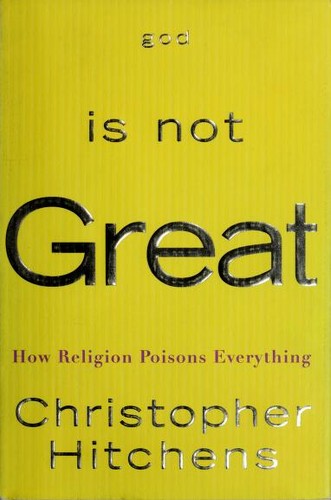
Talk to God Is Not Great: How Religion Poisons Everything like its author wrote you back.
Get the ideas that fit your life — not generic summaries.
- Chat with the book
- Audiobook-style main ideas
- Adapts to your life and goals
- Helps you take action
What it argues
God Is Not Great is Christopher Hitchens' comprehensive polemic against religion, published in 2007 as part of the wave of "New Atheist" books that included Dawkins' The God Delusion, Harris' The End of Faith, and Dennett's Breaking the Spell. Hitchens brings to the project a literary sensibility, a journalist's eye for the particular, and a combativeness that distinguishes his contribution from the others. His argument is not only that God probably doesn't exist but that religion — considered as an institution, a set of practices, and a way of thinking — has on balance been harmful to humanity.
The book moves through a catalog of religious crimes and absurdities: the complicity of religious institutions in slavery, colonialism, and child abuse; the epistemological irresponsibility of treating ancient texts as authoritative on matters of science and history; the psychological damage done by inducing guilt and shame in children; the political dangers of theocracy and the alliance of religion with totalitarianism. Hitchens is particularly strong on the Middle East, on the specific damage done by the monotheistic religions to sexual ethics, and on what he calls "the tawdry secret of religion" — that it did not originate in ethics but in fear and ignorance.
What it gets right
- 1.
Religion's claims to moral authority are undermined by its history: slavery, inquisition, child abuse, and theocratic violence are not distortions of religion but expressions of its institutional logic.
- 2.
The argument from design fails: natural selection explains the complexity of life without requiring a designer, and the evidence of natural suffering contradicts any benevolent creator.
- 3.
Religious texts are human documents — reflecting the knowledge, prejudices, and politics of their authors — and their claim to divine authority requires skeptical examination.
What it covers
Who wrote it
Christopher Hitchens (1949–2011) was a British-American author, journalist, and literary critic who wrote for Vanity Fair, The Atlantic, and many other publications. Born in Britain and a long-time resident of the United States, he was a socialist who became a prominent supporter of the Iraq War, and an atheist who devoted the last decade of his life to arguing against religion. His other books include No One Left to Lie To, The Missionary Position, Thomas Jefferson, and Mortality — written during his final illness. He died of esophageal cancer in 2011.
