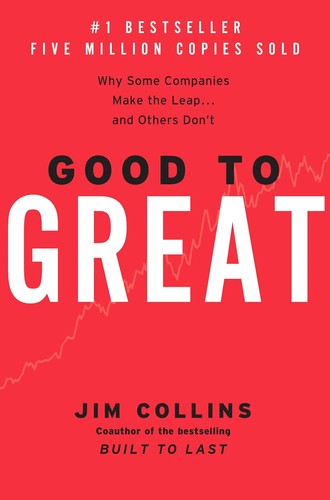
Talk to Good to Great like its author wrote you back.
Get the ideas that fit your life — not generic summaries.
- Chat with the book
- Audiobook-style main ideas
- Adapts to your life and goals
- Helps you take action
What it argues
Good to Great is Jim Collins's attempt to answer a deceptively simple question: why do some good companies make the leap to sustained greatness while most don't? Collins and his research team spent five years studying 1,435 companies, ultimately identifying eleven that made a sustained transition from good to great performance and then isolating what those companies had in common. The result is a set of interlocking concepts that Collins argues any organization can apply, regardless of industry.
The most counterintuitive finding is about leadership. The CEOs who led great companies weren't the charismatic, celebrity executives typical of business press coverage. Collins calls them Level 5 Leaders — people who combine fierce professional will with personal humility. They credit success to others and accept personal responsibility for failures. They think about institutional legacy rather than personal glory. Collins contrasts this with leaders he calls "I"-centric, who often produce short-term results while hollowing out the organization beneath them.
What it gets right
- 1.
Level 5 Leaders combine personal humility with fierce professional will. They credit others for success and take personal blame for failure, and they think about institutional legacy over personal fame.
- 2.
Great companies get the right people on the bus before deciding where to drive it. Who comes before what — strategy and direction follow once you have the right team.
- 3.
Confronting the brutal facts without losing faith is what Collins calls the Stockdale Paradox: maintain unwavering belief you will prevail while acknowledging the harshest current realities.
What it covers
Who wrote it
Jim Collins is an American researcher, author, and lecturer focused on what makes companies endure and thrive. He is the author or co-author of several influential business books, including Built to Last (with Jerry Porras), How the Mighty Fall, and Great by Choice. Collins spent much of his early career on the faculty at Stanford Graduate School of Business before founding a management research laboratory in Boulder, Colorado. Good to Great, published in 2001, drew on five years of systematic research across more than a thousand companies and has sold over four million copies worldwide.
