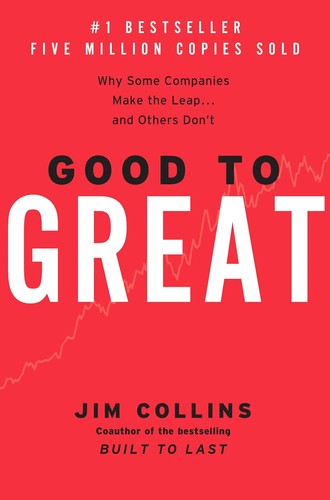
Good to Great by Jim Collins is a 2001 business book about leadership, organizational excellence, strategy. Level 5 Leaders combine personal humility with fierce professional will. They credit others for success and take personal blame for failure, and they think about institutional legacy over personal fame.
Summary
Good to Great is Jim Collins's attempt to answer a deceptively simple question: why do some good companies make the leap to sustained greatness while most don't? Collins and his research team spent five years studying 1,435 companies, ultimately identifying eleven that made a sustained transition from good to great performance and then isolating what those companies had in common. The result is a set of interlocking concepts that Collins argues any organization can apply, regardless of industry.
The most counterintuitive finding is about leadership. The CEOs who led great companies weren't the charismatic, celebrity executives typical of business press coverage. Collins calls them Level 5 Leaders — people who combine fierce professional will with personal humility. They credit success to others and accept personal responsibility for failures. They think about institutional legacy rather than personal glory. Collins contrasts this with leaders he calls "I"-centric, who often produce short-term results while hollowing out the organization beneath them.
Two other concepts anchor the book. First, the Hedgehog Concept: great companies found a single organizing idea that sat at the intersection of three questions — what can we be best in the world at, what drives our economic engine, and what are we deeply passionate about? They ignored everything outside that intersection with a discipline that lesser companies couldn't sustain. Second, the Flywheel: no single defining moment causes a great transformation. Sustained momentum comes from relentless, consistent effort in one direction until the flywheel builds enough weight to turn almost on its own.
Collins is careful to note what the research doesn't say. Technology, for instance, is an accelerator of momentum but not a cause of it. Mergers and acquisitions rarely appear in the great companies' histories. And the transition from good to great takes years, not quarters. The book's weakness is the small sample size and the hindsight bias inherent in reverse-engineering success stories. Several "great" companies Collins identified later stumbled badly, which Collins addressed in a follow-up. Even so, the frameworks — especially Level 5 Leadership and the Hedgehog Concept — remain among the most cited ideas in business literature.
Talk to Good to Great like its author wrote you back.
Get the ideas that fit your life — not generic summaries.
- Chat with the book
- Audiobook-style main ideas
- Adapts to your life and goals
- Helps you take action
Key takeaways
- 1.
Level 5 Leaders combine personal humility with fierce professional will. They credit others for success and take personal blame for failure, and they think about institutional legacy over personal fame.
- 2.
Great companies get the right people on the bus before deciding where to drive it. Who comes before what — strategy and direction follow once you have the right team.
- 3.
Confronting the brutal facts without losing faith is what Collins calls the Stockdale Paradox: maintain unwavering belief you will prevail while acknowledging the harshest current realities.
- 4.
The Hedgehog Concept is the intersection of what you can be best in the world at, what drives your economic engine, and what you are deeply passionate about. Great companies find it and stay inside it.
- 5.
A Culture of Discipline means people don't need to be managed — they are self-disciplined and fanatically consistent. The combination of an entrepreneurial ethic and disciplined behavior is rare and powerful.
- 6.
Technology accelerates momentum but never creates it. Great companies ask whether a new technology fits their Hedgehog Concept; they adopt it if it does and ignore it if it doesn't.
- 7.
The Flywheel effect: transformation feels like one big push, but it's actually hundreds of small consistent pushes in the same direction. Outsiders see a breakthrough; insiders experience cumulative effort.
- 8.
Good is the enemy of great. Most organizations never become great precisely because good is comfortable, and no one makes the case for more when things are already fine.
Discussion questions
Use these on your own, with a book club, or as chat starters in Superbook. Book club version, ready to copy or print →
- 1.
Collins argues that who comes before what — getting the right people precedes setting strategy. In your organization or team, is the sequence actually followed, or does it get inverted?
- 2.
Think of a leader you've worked under or observed closely. Where would you place them on Collins's Level 5 hierarchy, and what evidence leads you there?
- 3.
The Hedgehog Concept asks what you can be best in the world at, not just good at. For your own career, what honest answer do you give to that question?
- 4.
Collins's great companies confronted brutal facts while maintaining faith they would prevail. Is there a brutal fact in your current work life that you're avoiding or softening?
- 5.
The book found that charismatic, celebrity leadership often correlates with short-term results and long-term fragility. Does your own experience confirm or complicate that finding?
- 6.
How would you describe the Flywheel dynamic in a project or initiative you've been part of? At what point did consistent effort start to feel like momentum?
- 7.
Collins says great companies are disciplined about what they stop doing as much as what they start. What's something in your work or life that you should stop doing but haven't?
- 8.
The research found that great companies rarely used large acquisitions to drive their transformations. Why do you think companies reach for acquisitions instead of the slower Flywheel approach?
- 9.
Technology as accelerator, not cause: Collins says great companies adopt new technology selectively, only when it fits their core concept. How does your organization actually make technology decisions?
- 10.
Several companies Collins labeled great — Circuit City, Fannie Mae — later collapsed badly. Does that undermine the book's findings, or does it say something else?
- 11.
If you applied the Hedgehog Concept to your personal career — what you can be best at, what drives your economic engine, and what you're passionate about — where do those three circles actually overlap right now?
- 12.
Collins says good is the enemy of great. Where in your life are you settling for good and telling yourself it's enough?
Themes
Frequently asked questions
-
Is Good to Great still worth reading?
Yes, with one caveat. Several companies Collins held up as models later failed badly, which he acknowledged in later work. The frameworks — Level 5 Leadership, the Hedgehog Concept, the Flywheel — remain widely used and genuinely useful. Read it for the concepts, not as a list of companies to emulate.
-
How long does it take to read Good to Great?
Around five to six hours at average reading pace for the 300-page book. The chapters are organized by concept and are self-contained, so it's practical to read one concept at a time and sit with it before moving forward.
-
What is the main idea of Good to Great?
That the leap from good performance to sustained greatness is achievable but requires specific disciplines: humble and determined leadership, brutal honesty about current reality, a single organizing concept executed with fanatical consistency, and patient momentum-building over years.
-
Who should read Good to Great?
Founders, executives, and managers trying to build durable organizations rather than chase short-term performance. It's also useful for anyone thinking about strategy or leadership in a nonprofit, a team, or their own career — the Hedgehog Concept translates well outside the corporate context.
-
What is the Level 5 Leader concept?
Collins's label for leaders who combine extreme personal humility with fierce, almost stubborn professional will. They give credit to their teams and to luck when things go well, and they take personal responsibility when things go badly. Collins found them in every company that made the good-to-great transition.
-
What's the Hedgehog Concept in plain terms?
It's the overlap of three questions: what can your organization be the best in the world at, what drives your economic engine, and what are you deeply passionate about. Great companies find that intersection and refuse to operate outside it, even when other opportunities look attractive.
Similar books
Built to Last: Successful Habits of Visionary Companies
Jim Collins and Jerry I. Porras
Zero to One: Notes on Startups, or How to Build the Future
Peter Thiel
Start with Why
Simon Sinek
Outliers: The Story of Success
Malcolm Gladwell
Good to Great vs.
Deciding between two books? Good to Great vs Built to Last .
