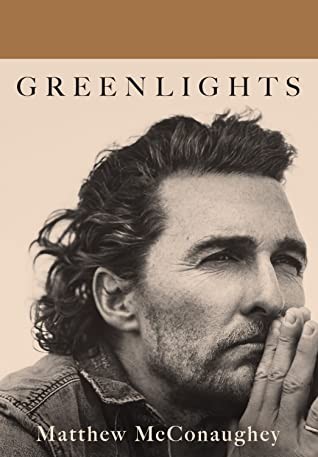
Talk to Greenlights like its author wrote you back.
Get the ideas that fit your life — not generic summaries.
- Chat with the book
- Audiobook-style main ideas
- Adapts to your life and goals
- Helps you take action
Greenlights, in detail
Greenlights is Matthew McConaughey's memoir-philosophy hybrid, built around decades of journals he kept starting in his teens. The central conceit is that life's events can be sorted into traffic light colors: red lights that stop you, yellow lights that slow you down, and green lights that propel you forward. McConaughey argues that what looks like a red light in the moment often turns out to be the event that made a green light possible later. It's a simple framework, and he doesn't overwork it — the book is more personal history than systematic philosophy.
McConaughey grew up in Uvalde, Texas, son of a father who was openly volatile and a mother he describes as one of the most formidable people he has ever known. His childhood accounts are vivid: his parents divorced and remarried each other three times, his father died during sex with his mother, and the family's particular code of toughness and affection runs through everything McConaughey writes. The family scenes are the book's strongest material. They are specific and strange in ways that generic memoir writing rarely allows.
His career narrative is episodic. The romantic comedy period, the deliberate exit from romantic comedies, the long years of lower-profile films while Hollywood waited for him to come back to genre work, and the eventual renaissance that led to Dallas Buyers Club and True Detective are covered without false modesty but also without the self-mythologizing that can make celebrity memoirs unreadable. McConaughey is candid that he made the choices he made because they felt right, not because they were strategically sound.
The book includes poetry, lists, journal fragments, and extended philosophical asides. That structure will not work for every reader. Greenlights is not linear and it is not particularly interested in being a traditional narrative. What it is, consistently, is the authentic expression of a specific sensibility — loose, Southern, physical, fond of aphorism, and genuinely curious about how to live well. Whether that sensibility appeals to you will determine whether the book does.
The big ideas
- 1.
The 'greenlights' framework argues that obstacles and setbacks often create the conditions for later success, and that the skill is learning to recognize the green light that comes after the red.
- 2.
McConaughey's journals, kept since his teens, form the raw material of the book. That source base makes it more honest than most celebrity memoirs — he is quoting himself at the time rather than reconstructing from comfortable distance.
- 3.
His family, particularly his father, is depicted with the kind of complicated love that resists reduction. The specific strangeness of his upbringing is treated as resource rather than wound.
