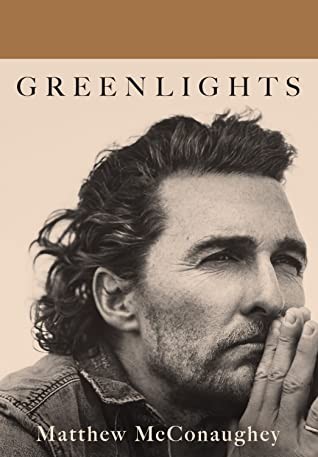
Greenlights by Matthew McConaughey is a 2020 memoir book about self-discovery, identity, success. The 'greenlights' framework argues that obstacles and setbacks often create the conditions for later success, and that the skill is learning to recognize the green light that comes after the red.
Summary
Greenlights is Matthew McConaughey's memoir-philosophy hybrid, built around decades of journals he kept starting in his teens. The central conceit is that life's events can be sorted into traffic light colors: red lights that stop you, yellow lights that slow you down, and green lights that propel you forward. McConaughey argues that what looks like a red light in the moment often turns out to be the event that made a green light possible later. It's a simple framework, and he doesn't overwork it — the book is more personal history than systematic philosophy.
McConaughey grew up in Uvalde, Texas, son of a father who was openly volatile and a mother he describes as one of the most formidable people he has ever known. His childhood accounts are vivid: his parents divorced and remarried each other three times, his father died during sex with his mother, and the family's particular code of toughness and affection runs through everything McConaughey writes. The family scenes are the book's strongest material. They are specific and strange in ways that generic memoir writing rarely allows.
His career narrative is episodic. The romantic comedy period, the deliberate exit from romantic comedies, the long years of lower-profile films while Hollywood waited for him to come back to genre work, and the eventual renaissance that led to Dallas Buyers Club and True Detective are covered without false modesty but also without the self-mythologizing that can make celebrity memoirs unreadable. McConaughey is candid that he made the choices he made because they felt right, not because they were strategically sound.
The book includes poetry, lists, journal fragments, and extended philosophical asides. That structure will not work for every reader. Greenlights is not linear and it is not particularly interested in being a traditional narrative. What it is, consistently, is the authentic expression of a specific sensibility — loose, Southern, physical, fond of aphorism, and genuinely curious about how to live well. Whether that sensibility appeals to you will determine whether the book does.
Talk to Greenlights like its author wrote you back.
Get the ideas that fit your life — not generic summaries.
- Chat with the book
- Audiobook-style main ideas
- Adapts to your life and goals
- Helps you take action
Key takeaways
- 1.
The 'greenlights' framework argues that obstacles and setbacks often create the conditions for later success, and that the skill is learning to recognize the green light that comes after the red.
- 2.
McConaughey's journals, kept since his teens, form the raw material of the book. That source base makes it more honest than most celebrity memoirs — he is quoting himself at the time rather than reconstructing from comfortable distance.
- 3.
His family, particularly his father, is depicted with the kind of complicated love that resists reduction. The specific strangeness of his upbringing is treated as resource rather than wound.
- 4.
The decision to step away from romantic comedies when he was one of Hollywood's highest-paid stars in that genre is presented as a necessary loss of identity before a new one could form.
- 5.
McConaughey's time in Africa — he spent several months in Mali doing volunteer work — is treated as a significant reorientation, though the account remains personal rather than analytical about what he was seeing.
- 6.
The book argues that discomfort is information. Most of the green lights McConaughey identifies came out of periods that were uncomfortable or objectively worse than what preceded them.
- 7.
His philosophy of personal accountability is persistent: he consistently frames his circumstances as choices rather than as things that happened to him, even in situations where the framing feels like more credit than he's owed.
- 8.
The book is explicitly a self-portrait, not an argument. McConaughey is not trying to tell readers what to do. He is describing how he has tried to live, and leaving the application to the reader.
Discussion questions
Use these on your own, with a book club, or as chat starters in Superbook. Book club version, ready to copy or print →
- 1.
The greenlights framework reframes setbacks as deferred advantages. Is that a genuinely useful way to process difficulty, or is it a retrospective rationalization that only works when things eventually go well?
- 2.
McConaughey's philosophy emphasizes personal accountability and the idea that he chose his circumstances. Where does that framing become difficult to apply?
- 3.
His family is depicted as bizarre and loving in roughly equal measure. Does the way he writes about his father tell you something about how he processes complicated relationships?
- 4.
The pivot away from romantic comedies cost him years of lower-profile work and was widely seen as a mistake at the time. What does his account of that period suggest about the risks of trusting your own instincts against external consensus?
- 5.
The book mixes memoir, poetry, journal fragments, and philosophy. Did that hybrid structure work for you, or did it feel like evasion of conventional narrative?
- 6.
McConaughey's Africa sections are present but relatively brief. What would you want a celebrity memoir to do differently when it touches on experience in a less familiar part of the world?
- 7.
He claims he has never smoked weed before noon. That specific self-imposed rule is offered as a form of discipline. What self-imposed rules do you use to structure your own choices?
- 8.
The book is often described as aspirational. Is that a compliment or a warning?
- 9.
McConaughey's account of his mother is one of the most vivid portraits in the book. Does reading about a parent through an adult child's eyes ever feel fully reliable to you?
- 10.
He describes walking out of a potential film deal that would have made him enormously rich because it felt wrong. How much do you trust that kind of instinct in yourself, and how do you distinguish it from fear or arrogance?
- 11.
Greenlights was a bestseller despite being an unusual, non-linear book. What does its commercial success tell you about what readers are looking for in memoir?
- 12.
If you were to apply the greenlights framework to your own life, what's the red light that turned out to be a green light in retrospect?
Themes
Frequently asked questions
-
Is Greenlights worth reading?
If you're open to a non-linear memoir that reads as personal philosophy as much as narrative, yes. If you want a conventional Hollywood story with a clear arc, it will frustrate you. The book is most useful as a study in a specific sensibility rather than as a template.
-
How long does it take to read Greenlights?
Around five hours at average reading pace, though the structure — poetry, lists, journal fragments interspersed with longer sections — means the experience varies. Many readers dip in and out rather than reading linearly.
-
What is the greenlights philosophy?
McConaughey argues that life's events can be understood as red lights, yellow lights, and green lights. The core idea is that red lights often create the conditions for green lights later, and that recognizing that pattern makes difficulty more navigable.
-
Is this a typical celebrity memoir?
No. It lacks the conventional before-and-after arc, the industry gossip, and the chronological structure most celebrity memoirs use. It is closer to a personal philosophy illustrated by stories than a career account.
-
Who should read Greenlights?
Readers who enjoy personal philosophy, aphorism, and the kind of memoir that prioritizes texture over narrative drive. Fans of McConaughey who want to understand how he thinks about his life rather than what he has done will find it more satisfying than those looking for Hollywood insider material.
Similar books
Becoming
Michelle Obama
Shoe Dog: A Memoir by the Creator of Nike
Phil Knight
Open: An Autobiography
Andre Agassi
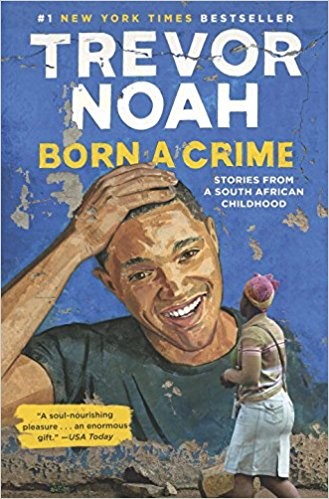
Born a Crime: Stories from a South African Childhood
Trevor Noah
