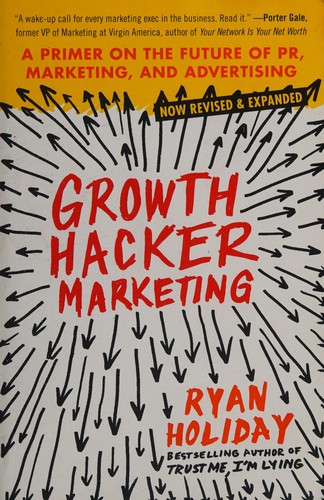
Talk to Growth Hacker Marketing like its author wrote you back.
Get the ideas that fit your life — not generic summaries.
- Chat with the book
- Audiobook-style main ideas
- Adapts to your life and goals
- Helps you take action
Growth Hacker Marketing, in detail
Growth Hacker Marketing is Ryan Holiday's short, accessible introduction to a marketing philosophy that emerged from Silicon Valley startups in the early 2010s. Holiday argues that the traditional marketing funnel — expensive advertising campaigns, press attention, brand awareness spending — is increasingly irrelevant for early-stage products, and that a different approach focused on engineering growth into the product itself and measuring everything has replaced it.
The central argument is that the most successful modern products achieve growth not primarily through marketing spend but through product-market fit and built-in virality. Holiday walks through examples including Hotmail, Dropbox, and Airbnb, showing how each company found their explosive growth not by outspending competitors on advertising but by redesigning the product or the onboarding experience to generate referrals. Hotmail's email signature, Dropbox's referral program, and Airbnb's Craigslist integration are the canonical cases. The pattern in each is that someone asked "how can the product market itself?" rather than "how much should we spend on ads?"
Holiday covers the growth funnel — acquisition, activation, retention, revenue, referral — and argues that most traditional marketers focus almost exclusively on acquisition while ignoring activation and retention, which is where most products actually fail or succeed. A product with weak retention cannot be fixed by pouring more acquisition spend on top of it.
The book is short by design — Holiday expanded it from a shorter essay — and that shows in the thinness of the tactical chapters. The case studies are well-chosen and clearly explained, but the book stops well short of giving a practitioner enough to run a growth program. It's best read as an introduction to a mindset shift rather than a how-to guide. Readers looking for tactical depth should treat it as a starting point and move to more detailed works on product-led growth or conversion optimization.
The big ideas
- 1.
Product-market fit precedes marketing. Spending on acquisition before people love the product accelerates failure.
- 2.
The most effective growth comes from engineering virality into the product itself — referral programs, shareable outputs, network effects — not from paid campaigns.
- 3.
Traditional marketing's obsession with acquisition ignores retention. A leaky bucket cannot be filled by running the tap faster.
