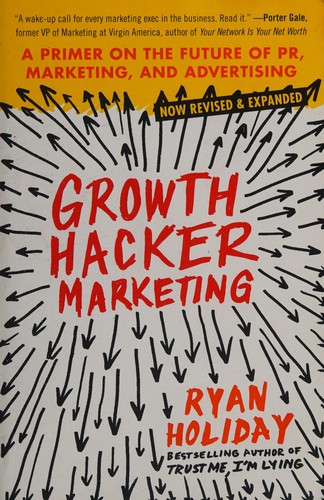
Growth Hacker Marketing by Ryan Holiday is a 2014 business book about marketing, growth, product-market fit. Product-market fit precedes marketing. Spending on acquisition before people love the product accelerates failure.
Summary
Growth Hacker Marketing is Ryan Holiday's short, accessible introduction to a marketing philosophy that emerged from Silicon Valley startups in the early 2010s. Holiday argues that the traditional marketing funnel — expensive advertising campaigns, press attention, brand awareness spending — is increasingly irrelevant for early-stage products, and that a different approach focused on engineering growth into the product itself and measuring everything has replaced it.
The central argument is that the most successful modern products achieve growth not primarily through marketing spend but through product-market fit and built-in virality. Holiday walks through examples including Hotmail, Dropbox, and Airbnb, showing how each company found their explosive growth not by outspending competitors on advertising but by redesigning the product or the onboarding experience to generate referrals. Hotmail's email signature, Dropbox's referral program, and Airbnb's Craigslist integration are the canonical cases. The pattern in each is that someone asked "how can the product market itself?" rather than "how much should we spend on ads?"
Holiday covers the growth funnel — acquisition, activation, retention, revenue, referral — and argues that most traditional marketers focus almost exclusively on acquisition while ignoring activation and retention, which is where most products actually fail or succeed. A product with weak retention cannot be fixed by pouring more acquisition spend on top of it.
The book is short by design — Holiday expanded it from a shorter essay — and that shows in the thinness of the tactical chapters. The case studies are well-chosen and clearly explained, but the book stops well short of giving a practitioner enough to run a growth program. It's best read as an introduction to a mindset shift rather than a how-to guide. Readers looking for tactical depth should treat it as a starting point and move to more detailed works on product-led growth or conversion optimization.
Talk to Growth Hacker Marketing like its author wrote you back.
Get the ideas that fit your life — not generic summaries.
- Chat with the book
- Audiobook-style main ideas
- Adapts to your life and goals
- Helps you take action
Key takeaways
- 1.
Product-market fit precedes marketing. Spending on acquisition before people love the product accelerates failure.
- 2.
The most effective growth comes from engineering virality into the product itself — referral programs, shareable outputs, network effects — not from paid campaigns.
- 3.
Traditional marketing's obsession with acquisition ignores retention. A leaky bucket cannot be filled by running the tap faster.
- 4.
Growth hackers measure everything and run experiments constantly. The unit of decision-making is the test, not the campaign.
- 5.
The full growth funnel is acquisition, activation, retention, revenue, referral. Most organizations work only on the first and last stages.
- 6.
Identifying the first 1,000 true fans through targeted, unglamorous outreach almost always outperforms broad brand awareness campaigns for early products.
- 7.
Platform leverage beats paid media. Plugging into an existing large platform (Craigslist, Gmail, App Store) can deliver growth that no ad budget can replicate.
Discussion questions
Use these on your own, with a book club, or as chat starters in Superbook. Book club version, ready to copy or print →
- 1.
Holiday argues that product-market fit must come before marketing spend. How do you know when you have enough product-market fit to justify scaling acquisition?
- 2.
Which of the examples — Hotmail, Dropbox, Airbnb — most directly maps to how you think about your own product or organization? What does the comparison reveal?
- 3.
The book focuses heavily on early-stage startup growth. How much of the growth hacker philosophy applies to an established company trying to grow a mature product?
- 4.
Holiday says most marketing teams focus on acquisition and ignore activation and retention. Is that true in your experience? What does the data at your organization show?
- 5.
What would it mean to make your product 'market itself'? What referral or sharing mechanism doesn't currently exist in your product or service?
- 6.
The growth funnel ends with referral. What is the referral rate of your current product or service, and what would move it?
- 7.
Holiday is skeptical of traditional press and PR as growth drivers. Do you agree that earned media is overvalued relative to product-led virality, or does it depend on the category?
- 8.
Running constant experiments requires a tolerance for being wrong often. How does the culture of your organization handle experiments that don't produce the expected result?
- 9.
The book is short and high-level. What question does it raise for you that it doesn't answer, and where would you go to find a more detailed answer?
- 10.
Holiday profiles products with inherent shareability. What makes a product shareable, and does that quality exist in what you're currently building or selling?
- 11.
Growth hacking has a reputation for sometimes being manipulative — dark patterns, aggressive push notifications, manufactured urgency. Where is the line, and does Holiday address it adequately?
Themes
Frequently asked questions
-
Is Growth Hacker Marketing worth reading?
As a quick introduction to a marketing philosophy, yes. It's short, clearly argued, and the case studies are well chosen. If you want tactical depth on running a growth program, you'll need to supplement it with more detailed resources on conversion optimization or product-led growth.
-
How long does it take to read?
About two hours. The book is short by design — Holiday expanded it from an essay and it reads more like an extended argument than a comprehensive guide. Most readers finish it in a single sitting.
-
What is growth hacking?
A marketing approach, originally associated with Silicon Valley startups, that prioritizes product-market fit, data-driven experimentation, and engineering virality into the product over traditional advertising spend. The goal is to find scalable, low-cost growth mechanisms rather than buying attention.
-
Who should read this book?
Founders and marketers at early-stage products who are questioning whether traditional marketing frameworks apply to them. Also useful for product managers who want to understand how growth and product decisions intersect.
-
What's the most actionable idea?
Map your full growth funnel — acquisition, activation, retention, revenue, referral — and measure the drop-off at each stage. Most products hemorrhage users at activation and retention. Fixing those leaks before increasing acquisition spend is almost always a better use of resources.
Similar books
Traction: How Any Startup Can Achieve Explosive Customer Growth
Gabriel Weinberg and Justin Mares
The Lean Startup
Eric Ries

Contagious: Why Things Catch On
Jonah Berger
Hooked: How to Build Habit-Forming Products
Nir Eyal
