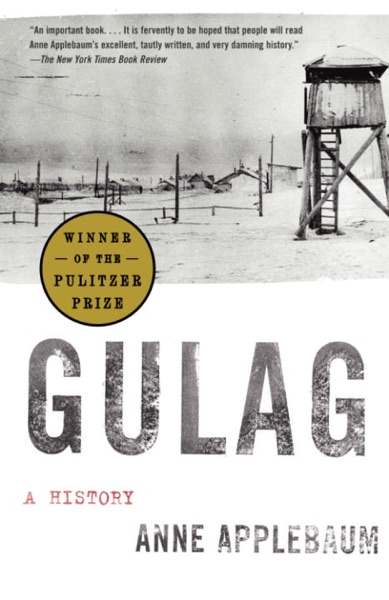
Talk to Gulag: A History like its author wrote you back.
Get the ideas that fit your life — not generic summaries.
- Chat with the book
- Audiobook-style main ideas
- Adapts to your life and goals
- Helps you take action
What it argues
Anne Applebaum's Gulag is the first comprehensive English-language history of the Soviet forced labor camp system, drawing on KGB archives opened briefly after 1991, survivor memoirs, and interviews with former prisoners and guards. It won the Pulitzer Prize in 2004. The system at its peak housed somewhere between 15 and 18 million people, with mortality rates that varied enormously by era and location. Applebaum's central argument is that the Gulag was not an aberration but a structural feature of the Soviet economy and political system, and that its near-absence from Western historical consciousness compared to the Nazi concentration camps is itself historically significant.
The book is organized in three parts. The first is historical: how the camp system developed from the Bolshevik seizure of power through the Lenin era, the massive expansion under Stalin, and the slow post-Stalin decline. The camps were not simply prisons. They were economic enterprises, supplying forced labor to mines, forests, railways, and construction projects across Siberia and the Soviet Far East. The economics of the Gulag — how it was funded, how prisoners were fed and worked, what targets the planners set — receive unusual attention. The camps were brutal partly by design and partly through administrative indifference.
What it gets right
- 1.
The Gulag was a systemic institution, not a collection of exceptional abuses. It was integrated into Soviet economic planning and ran for over three decades at industrial scale.
- 2.
At its peak in the late Stalin era, the camp system held 15 to 18 million people simultaneously. Over its history, perhaps 18 million passed through it; millions died.
- 3.
The camps served dual purposes: political control through terror and economic exploitation of regions too harsh or remote for voluntary labor.
What it covers
Who wrote it
Anne Applebaum is a staff writer at The Atlantic and a senior fellow at Johns Hopkins University's School of Advanced International Studies. She won the Pulitzer Prize for Gulag: A History in 2004 and is also the author of Iron Curtain: The Crushing of Eastern Europe 1944–1956, Red Famine: Stalin's War on Ukraine, and Twilight of Democracy. She has lived and worked in Poland since the 1990s and has spent her career documenting the history and legacy of Soviet communism. She is among the leading historians of twentieth-century Eastern Europe writing in English.
