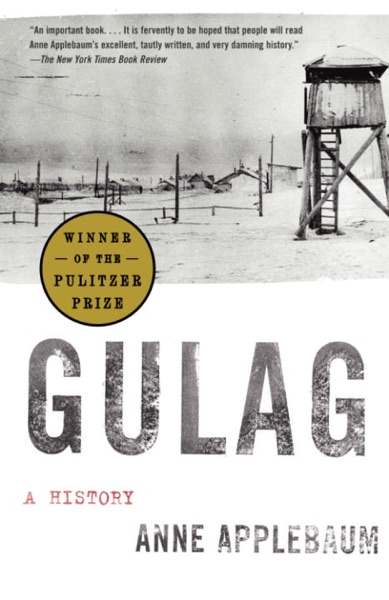
Gulag: A History by Anne Applebaum is a 2003 history book about soviet history, political repression, totalitarianism. The Gulag was a systemic institution, not a collection of exceptional abuses. It was integrated into Soviet economic planning and ran for over three decades at industrial scale.
Summary
Anne Applebaum's Gulag is the first comprehensive English-language history of the Soviet forced labor camp system, drawing on KGB archives opened briefly after 1991, survivor memoirs, and interviews with former prisoners and guards. It won the Pulitzer Prize in 2004. The system at its peak housed somewhere between 15 and 18 million people, with mortality rates that varied enormously by era and location. Applebaum's central argument is that the Gulag was not an aberration but a structural feature of the Soviet economy and political system, and that its near-absence from Western historical consciousness compared to the Nazi concentration camps is itself historically significant.
The book is organized in three parts. The first is historical: how the camp system developed from the Bolshevik seizure of power through the Lenin era, the massive expansion under Stalin, and the slow post-Stalin decline. The camps were not simply prisons. They were economic enterprises, supplying forced labor to mines, forests, railways, and construction projects across Siberia and the Soviet Far East. The economics of the Gulag — how it was funded, how prisoners were fed and worked, what targets the planners set — receive unusual attention. The camps were brutal partly by design and partly through administrative indifference.
The second part describes daily life inside the camps: arrest, transport, initial incarceration, the social hierarchies of the prisoner population, the role of criminal prisoners, the varieties of work, the attempts at resistance, and the occasional informal accommodations between guards and prisoners. Applebaum is meticulous here, drawing on memoirs from writers including Varlam Shalamov and Alexander Solzhenitsyn alongside less famous accounts. The diversity of the prisoner population — intellectuals, peasants, foreign communists, POWs, ordinary citizens caught in quota-driven arrest campaigns — is one of the book's most important points.
The third part covers liberation, return, and the long shadow of the camps in Russian and international memory. Survivors who returned to Soviet society were often required to remain silent; speaking about the camps invited re-arrest. The rehabilitation process under Khrushchev was partial and short-lived. Applebaum traces the suppression of Gulag memory into the post-Soviet era and the political reasons that memory has never received the public accounting that, say, Nazi crimes received in Germany. This remains unfinished business in Russia today.
Talk to Gulag: A History like its author wrote you back.
Get the ideas that fit your life — not generic summaries.
- Chat with the book
- Audiobook-style main ideas
- Adapts to your life and goals
- Helps you take action
Key takeaways
- 1.
The Gulag was a systemic institution, not a collection of exceptional abuses. It was integrated into Soviet economic planning and ran for over three decades at industrial scale.
- 2.
At its peak in the late Stalin era, the camp system held 15 to 18 million people simultaneously. Over its history, perhaps 18 million passed through it; millions died.
- 3.
The camps served dual purposes: political control through terror and economic exploitation of regions too harsh or remote for voluntary labor.
- 4.
Arrest was often arbitrary — quota-driven campaigns swept up people who had done nothing wrong alongside actual opponents of the regime. Guilt was irrelevant.
- 5.
The prisoner population was extraordinarily diverse: Old Bolsheviks, foreign communists, peasants, engineers, criminals, and ordinary citizens all shared the camps.
- 6.
Survival strategies varied. Cultural life — illegal but widespread — included theatrical performances, poetry, and music. Connections to criminal prisoners sometimes provided protection.
- 7.
Post-Stalin, survivors who returned to Soviet society faced pressure to remain silent. The culture of Gulag denial was enforced as systematically as the camps themselves.
- 8.
The West's moral asymmetry between Nazi and Soviet crimes — the Holocaust is taught widely; the Gulag remains obscure — reflects political choices as much as historical judgment.
Discussion questions
Use these on your own, with a book club, or as chat starters in Superbook. Book club version, ready to copy or print →
- 1.
Applebaum argues the Gulag was structurally necessary to the Soviet system, not a deviation from it. What implications does that have for how we evaluate Soviet ideology?
- 2.
The arrest campaigns were quota-driven: officials had to arrest a certain number, so they did. What does that reveal about how bureaucratic systems can become instruments of atrocity?
- 3.
Survivor memoirs vary enormously in how they describe life in the camps. What accounts for those differences, and how should historians weigh contradictory testimony?
- 4.
Why did the Gulag receive so much less international attention than the Nazi concentration camps, and do you find any of those reasons defensible?
- 5.
Applebaum traces how memory of the camps was suppressed within the Soviet Union. What happens to a society when it cannot account for mass atrocities in its own recent past?
- 6.
The book documents cultural life inside the camps — performances, poetry, friendship. What does that say about human resilience, and what are its limits?
- 7.
Many foreign communists who went to the Soviet Union out of genuine idealism ended up in the camps. How do you evaluate their political choices in retrospect?
- 8.
The Gulag's economic function was often inefficient — camp labor was less productive than free labor. Why did the system persist even on its own economic terms?
- 9.
What does the history of the Gulag suggest about how warning signs of political repression should be recognized and responded to?
- 10.
Applebaum says the absence of a Russian reckoning with the Gulag has consequences for Russian political culture today. Do you find that argument convincing?
- 11.
Which individual story or episode from the book stayed with you most, and why?
- 12.
How does reading this book change, if at all, how you think about the political movements in your own country that promise radical social transformation?
Themes
Frequently asked questions
-
Is Gulag: A History worth reading?
Yes, if you want the fullest available English-language account of the Soviet camp system. It is thorough, scrupulously documented, and ultimately humane in the way it treats survivors' testimony. The length is justified by the scope of the subject.
-
How long does it take to read Gulag?
It is a long book — around 600 pages of text plus extensive footnotes. Expect 18 to 22 hours at average reading pace. Most readers work through it over several weeks rather than in one sitting.
-
What makes Gulag different from Solzhenitsyn's The Gulag Archipelago?
Solzhenitsyn's work is personal testimony and literary polemic; Applebaum's is a historian's synthesis. Applebaum had access to Soviet archives that Solzhenitsyn did not, and she approaches the subject empirically rather than through the lens of a survivor's experience. Both are essential.
-
Who should read this book?
Anyone interested in Soviet history, totalitarianism, or the mechanics of political repression. It is also essential reading for anyone who wants to understand why survivors of Soviet communism in Eastern Europe respond so differently to political events than people in the West.
-
How does the Gulag compare to the Nazi concentration camps?
The camps served different primary purposes: the Nazi camps were designed mainly for extermination; the Soviet camps were primarily labor enterprises in which death was a byproduct of conditions and callousness rather than the explicit goal, though in specific periods and locations the distinction blurred significantly.
Similar books

The Rise and Fall of the Third Reich
William L. Shirer

The Diary of a Young Girl
Anne Frank
Man's Search for Meaning
Viktor E. Frankl
Sapiens: A Brief History of Humankind
Yuval Noah Harari
