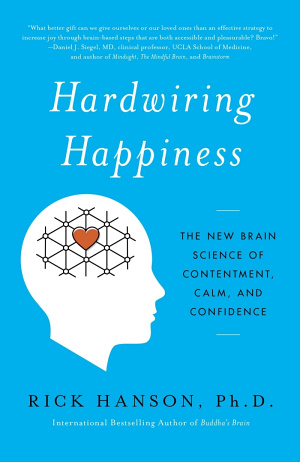
Talk to Hardwiring Happiness: The New Brain Science of Contentment, Calm, and Confidence like its author wrote you back.
Get the ideas that fit your life — not generic summaries.
- Chat with the book
- Audiobook-style main ideas
- Adapts to your life and goals
- Helps you take action
What it argues
Rick Hanson is a neuropsychologist and meditation teacher, and this book is his attempt to explain why wellbeing is so hard to sustain and what the brain science suggests you can do about it. The core observation is the same negativity bias that underlies much contemporary behavioral science: the brain is wired to hold onto bad experiences and let good ones slip away. This asymmetry made evolutionary sense — it was more dangerous to forget a threat than to forget a reward — but in a modern environment where existential threats are rare, it produces chronic background stress and resistance to contentment.
Hanson's central technique, which he calls "taking in the good," is simple in concept. When a positive experience occurs — a moment of pleasure, satisfaction, gratitude, or connection — you deliberately pause to hold it in attention for at least ten to thirty seconds, allowing it to sink in. The neurological claim is that this extended attention allows the transient positive state to consolidate into more stable neural structure: a positive experience becomes a positive resource rather than evaporating. The brain's plasticity means that what fires together, wires together, and deliberate attention to good states shifts the baseline.
What it gets right
- 1.
The brain evolved to let negative experiences stick and positive ones slide. This asymmetry kept ancestors alive but produces chronic background dissatisfaction in modern life.
- 2.
Brain plasticity means that experience shapes neural structure — what you attend to repeatedly, you become. Deliberately attending to positive states can shift the baseline toward wellbeing.
- 3.
Taking in the good: when a positive experience occurs, pause for ten to thirty seconds to let it register fully, rather than moving immediately to the next thing.
What it covers
Who wrote it
Rick Hanson is a clinical psychologist, senior fellow at UC Berkeley's Greater Good Science Center, and a meditation teacher in the neurodharma tradition. He holds a PhD from the California School of Professional Psychology and has practiced Buddhist meditation for over thirty years. He is the author of several books including Buddha's Brain, Just One Thing, and Neurodharma, all of which explore the intersection of contemplative practice and contemporary neuroscience. He founded the Wellspring Institute for Neuroscience and Contemplative Wisdom. His work is aimed at making mindfulness-based approaches accessible to people without a meditation background.
