Hardwiring Happiness: The New Brain Science of Contentment, Calm, and Confidence by Rick Hanson is a 2013 psychology book about happiness, neuroscience, mindfulness. The brain evolved to let negative experiences stick and positive ones slide. This asymmetry kept ancestors alive but produces chronic background dissatisfaction in modern life.
Summary
Rick Hanson is a neuropsychologist and meditation teacher, and this book is his attempt to explain why wellbeing is so hard to sustain and what the brain science suggests you can do about it. The core observation is the same negativity bias that underlies much contemporary behavioral science: the brain is wired to hold onto bad experiences and let good ones slip away. This asymmetry made evolutionary sense — it was more dangerous to forget a threat than to forget a reward — but in a modern environment where existential threats are rare, it produces chronic background stress and resistance to contentment.
Hanson's central technique, which he calls "taking in the good," is simple in concept. When a positive experience occurs — a moment of pleasure, satisfaction, gratitude, or connection — you deliberately pause to hold it in attention for at least ten to thirty seconds, allowing it to sink in. The neurological claim is that this extended attention allows the transient positive state to consolidate into more stable neural structure: a positive experience becomes a positive resource rather than evaporating. The brain's plasticity means that what fires together, wires together, and deliberate attention to good states shifts the baseline.
The book goes further than the single technique. Hanson covers a four-step process he calls HEAL: Have a beneficial experience, Enrich it, Absorb it, and optionally Link it to related negative material you want to neutralize. The neuroscience supporting each step is explained accessibly, and Hanson is honest about the limits of the evidence — the practice is reasonable given what's known about brain plasticity, but the direct empirical support for the specific protocol is thinner than for the broader field.
Hardwiring Happiness sits between popular psychology and the self-help genre, and readers looking for dense scientific exposition will find it lighter than they might want. The writing is warm and the techniques are genuinely practical, but the book benefits from being read as a guide to practice rather than a rigorous scientific text. It pairs well with formal mindfulness instruction. For readers who find that their good moments don't stick the way their bad ones do, the central insight is both simple and worth taking seriously.
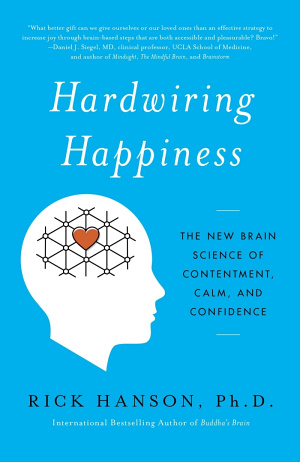
Talk to Hardwiring Happiness: The New Brain Science of Contentment, Calm, and Confidence like its author wrote you back.
Get the ideas that fit your life — not generic summaries.
- Chat with the book
- Audiobook-style main ideas
- Adapts to your life and goals
- Helps you take action
Key takeaways
- 1.
The brain evolved to let negative experiences stick and positive ones slide. This asymmetry kept ancestors alive but produces chronic background dissatisfaction in modern life.
- 2.
Brain plasticity means that experience shapes neural structure — what you attend to repeatedly, you become. Deliberately attending to positive states can shift the baseline toward wellbeing.
- 3.
Taking in the good: when a positive experience occurs, pause for ten to thirty seconds to let it register fully, rather than moving immediately to the next thing.
- 4.
The HEAL process — Have, Enrich, Absorb, Link — is Hanson's structured protocol for converting positive experiences into lasting neural resources.
- 5.
Most psychological resources — resilience, compassion, equanimity — are skills that can be built through practice, not fixed traits. The brain that produces them can be strengthened.
- 6.
The negativity bias is not fixed. While it's a default, deliberate practice can shift the ratio of positive to negative material in working memory and in long-term emotional tone.
- 7.
Enriching a positive experience means intensifying it: noticing it in the body, finding multiple aspects of it that feel good, letting yourself appreciate it rather than being modest about it.
- 8.
Linking positive material to negative: holding a positive state in mind while gently introducing a mild negative one can reduce the charge of the negative through reconsolidation.
Discussion questions
Use these on your own, with a book club, or as chat starters in Superbook. Book club version, ready to copy or print →
- 1.
Hanson argues that positive experiences don't stick because the brain evolved to let them go. Does this match your experience? Which kinds of good moments do you find hardest to hold onto?
- 2.
The technique of 'taking in the good' requires deliberately pausing during positive moments. What obstacles — habit, embarrassment, busyness — prevent you from doing this?
- 3.
The book makes a distinction between having a positive experience and installing it as a neural resource. What would it mean for your wellbeing to take this distinction seriously for a week?
- 4.
Hanson draws on neuroscience to support his practices but is honest that the direct evidence for his specific protocol is limited. Does that affect your willingness to try it?
- 5.
Think of a psychological resource you want more of — calm, courage, patience. What positive experiences in your recent life might be raw material for building it?
- 6.
The negativity bias affects memory. Think of a period in your life you remember as mostly hard. Is it possible the good moments were present but didn't register as fully?
- 7.
Hanson says modesty or discomfort can prevent people from letting positive experiences register. Where does that resistance come from for you?
- 8.
The HEAL protocol includes a 'link' step: holding positive material alongside negative material to reduce the negative charge. Does this sound credible to you? Where would you try it?
- 9.
How would your day look different if you treated every moment of pleasure, satisfaction, or connection as something worth thirty seconds of deliberate attention?
- 10.
Hanson comes from both clinical psychology and the meditation tradition. Where do you see those two influences shaping the book's approach differently from a pure neuroscience account?
- 11.
The book promises a shift in emotional baseline. Is that a goal you hold for yourself? What would a reliably calmer, more contented version of your daily experience actually look like?
Themes
Frequently asked questions
-
What is Hardwiring Happiness about?
It's Rick Hanson's account of why positive experiences don't stick as readily as negative ones, and a practical system for changing that. The central practice — 'taking in the good' — involves deliberately holding positive experiences in attention long enough for them to consolidate into lasting neural structure.
-
Is Hardwiring Happiness worth reading?
Yes, particularly if you find that your emotional baseline is harder to shift than you'd like. It's accessible and the techniques are genuinely practical. Readers wanting dense scientific citation should know it sits closer to the popular end of the psychology-neuroscience spectrum.
-
How is Hardwiring Happiness different from a mindfulness book?
Both draw on brain plasticity and attention training, but the focus differs. Mindfulness books typically focus on present-moment awareness and accepting experience as it is. Hardwiring Happiness focuses specifically on using positive experiences to build lasting psychological resources — it's more explicitly about growth than acceptance.
-
Who should read Hardwiring Happiness?
People who feel their positive moments don't seem to accumulate into greater overall wellbeing, and anyone who wants a neuroscience framing for why this happens and what to do about it. Also useful for therapists and coaches looking for structured interventions based on positive experience.
-
What's the most actionable technique in the book?
Taking in the good: when something good happens — a moment of pleasure, a small success, a warm interaction — deliberately pause for ten to thirty seconds to let it register. Stay with the feeling in your body, let it be a little bigger, and don't rush to the next thing. That's the practice, and you can start it today.
Similar books
The Happiness Hypothesis
Jonathan Haidt
Flourish: A Visionary New Understanding of Happiness and Well-being
Martin E. P. Seligman
Learned Optimism: How to Change Your Mind and Your Life
Martin E. P. Seligman
10% Happier
Dan Harris
