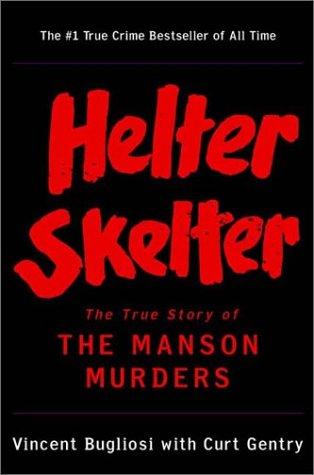
Talk to Helter Skelter: The True Story of the Manson Murders like its author wrote you back.
Get the ideas that fit your life — not generic summaries.
- Chat with the book
- Audiobook-style main ideas
- Adapts to your life and goals
- Helps you take action
Helter Skelter: The True Story of the Manson Murders, in detail
Helter Skelter is the account of the Tate-LaBianca murders of August 1969 written by Vincent Bugliosi, the Los Angeles deputy district attorney who prosecuted Charles Manson, with journalist Curt Gentry. First published in 1974, it remains the most detailed and widely read examination of the Manson case. Bugliosi's perspective is prosecutorial throughout — he is not a neutral narrator — but that vantage point is also the book's strength. He was inside the investigation, the grand jury proceedings, and the trial itself, and no subsequent account has matched the documentary depth of what he assembled.
The murders themselves are reconstructed in granular detail. On the nights of August 8 and 9, Manson's followers killed seven people in two separate houses in the Los Angeles hills. Sharon Tate, eight months pregnant, was among the victims. The killers left messages in blood on the walls. Los Angeles was terrified for months. The investigation stalled, nearly collapsed, and eventually succeeded only because of a series of accidents: a jailhouse informant, a tip about a knife, a coincidence involving a parking ticket. Bugliosi is honest about how close the case came to never being solved.
The more lasting part of the book concerns how Manson controlled his followers. He is depicted as a man of limited education and genuine charisma who used sexual manipulation, drug conditioning, sleep deprivation, and relentless psychological pressure to erase his followers' individual judgment. The Family's members were mostly young, mostly white, mostly from functional middle-class backgrounds. Manson's ability to reach them is treated not as freakish but as a disturbing demonstration of how ordinary susceptibility can be systematically exploited.
The trial was among the strangest in American history. Manson carved a swastika into his forehead. His female followers shaved their heads and camped on the sidewalk outside the courthouse. The defendants laughed during testimony about the murders. Bugliosi won anyway. The book works as both a true crime narrative and a case study in what happens when a justice system encounters defendants who have abandoned the shared premise that they should care about their own survival.
The big ideas
- 1.
Charles Manson did not personally commit the murders but was convicted of first-degree murder on a conspiracy theory — directing others to kill. The legal argument was Bugliosi's central challenge and his major achievement.
- 2.
The investigation nearly failed. Critical evidence was overlooked, the original detectives pursued wrong leads, and the case broke primarily through luck and an informant rather than systematic police work.
- 3.
Manson's control over his followers relied on techniques recognizable from cult psychology: isolation, sleep deprivation, sexual manipulation, drug use, and the systematic dissolution of individual identity.
