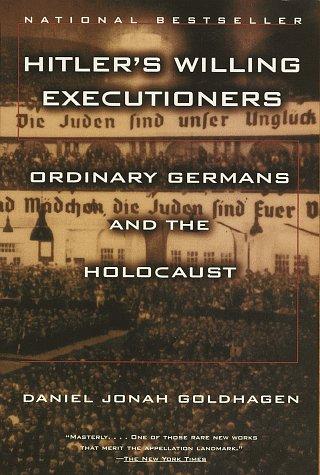
Talk to Hitler's Willing Executioners: Ordinary Germans and the Holocaust like its author wrote you back.
Get the ideas that fit your life — not generic summaries.
- Chat with the book
- Audiobook-style main ideas
- Adapts to your life and goals
- Helps you take action
Hitler's Willing Executioners: Ordinary Germans and the Holocaust, in detail
Hitler's Willing Executioners is Daniel Goldhagen's argument that the Holocaust was made possible by a specifically German form of antisemitism — what he calls "eliminationist antisemitism" — that was so deeply embedded in German culture by the twentieth century that ordinary Germans participated in the genocide willingly, not reluctantly, and often with evident enthusiasm. The book was a publishing sensation when it appeared in 1996, generating intense public debate and sharply divided scholarly reception.
Goldhagen builds his case primarily from three sources of evidence: the same Reserve Police Battalion 101 materials used by Christopher Browning in Ordinary Men, a study of Jewish labor camps run by German police, and an analysis of the death marches at the end of the war. Across all three cases, Goldhagen argues, what is striking is not the evidence of reluctance or coercion but of voluntarism and cruelty. The perpetrators were not acting from conformity or careerism. They were acting from belief.
The central claim is historicist and cultural: German antisemitism had by the 1800s evolved into a form that was uniquely virulent, uniquely eliminationist, and uniquely prepared to endorse and carry out mass murder when political conditions permitted. This argument requires Goldhagen to reject the situationist explanations of Browning, Milgram, and Arendt's "banality of evil" thesis, and to insist that the specifically German cultural context is what made the Holocaust distinctively German rather than a product of universal human tendencies.
The scholarly reception was largely critical. Historians objected that Goldhagen caricatured earlier perpetrator studies, that his reading of the evidence was selective, that his claim about uniquely German antisemitism was not adequately supported, and that his portrait of monolithic German culture ignored the substantial variation in antisemitic attitudes within Germany itself. The public reception was different: in Germany especially, the book sparked a significant popular engagement with questions of national responsibility that historians had been unable to generate. Whatever its scholarly limitations, Hitler's Willing Executioners performed a cultural function that purely academic history had not.
The big ideas
- 1.
Goldhagen argues that specifically German 'eliminationist antisemitism' — the belief that Jews must be physically eliminated rather than merely persecuted or expelled — had deep roots in German culture before Hitler.
- 2.
The evidence from police battalions, labor camps, and death marches shows perpetrators acting with discretion and voluntarism, not merely following orders under coercion, which Goldhagen takes as evidence of genuine belief.
- 3.
Goldhagen explicitly rejects situationist explanations — Milgram's obedience research, Browning's conformity analysis — as insufficient to explain the Holocaust without reference to ideology.
