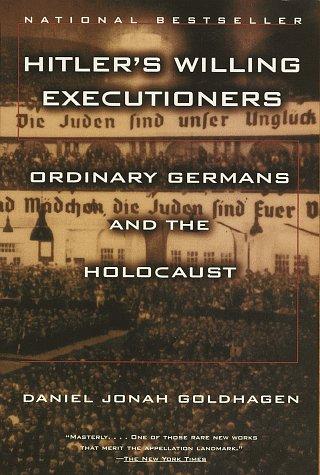
Hitler's Willing Executioners: Ordinary Germans and the Holocaust by Daniel Jonah Goldhagen is a 1996 history book about the holocaust, antisemitism, perpetrators. Goldhagen argues that specifically German 'eliminationist antisemitism' — the belief that Jews must be physically eliminated rather than merely persecuted or expelled — had deep roots in German culture before Hitler.
Summary
Hitler's Willing Executioners is Daniel Goldhagen's argument that the Holocaust was made possible by a specifically German form of antisemitism — what he calls "eliminationist antisemitism" — that was so deeply embedded in German culture by the twentieth century that ordinary Germans participated in the genocide willingly, not reluctantly, and often with evident enthusiasm. The book was a publishing sensation when it appeared in 1996, generating intense public debate and sharply divided scholarly reception.
Goldhagen builds his case primarily from three sources of evidence: the same Reserve Police Battalion 101 materials used by Christopher Browning in Ordinary Men, a study of Jewish labor camps run by German police, and an analysis of the death marches at the end of the war. Across all three cases, Goldhagen argues, what is striking is not the evidence of reluctance or coercion but of voluntarism and cruelty. The perpetrators were not acting from conformity or careerism. They were acting from belief.
The central claim is historicist and cultural: German antisemitism had by the 1800s evolved into a form that was uniquely virulent, uniquely eliminationist, and uniquely prepared to endorse and carry out mass murder when political conditions permitted. This argument requires Goldhagen to reject the situationist explanations of Browning, Milgram, and Arendt's "banality of evil" thesis, and to insist that the specifically German cultural context is what made the Holocaust distinctively German rather than a product of universal human tendencies.
The scholarly reception was largely critical. Historians objected that Goldhagen caricatured earlier perpetrator studies, that his reading of the evidence was selective, that his claim about uniquely German antisemitism was not adequately supported, and that his portrait of monolithic German culture ignored the substantial variation in antisemitic attitudes within Germany itself. The public reception was different: in Germany especially, the book sparked a significant popular engagement with questions of national responsibility that historians had been unable to generate. Whatever its scholarly limitations, Hitler's Willing Executioners performed a cultural function that purely academic history had not.
Talk to Hitler's Willing Executioners: Ordinary Germans and the Holocaust like its author wrote you back.
Get the ideas that fit your life — not generic summaries.
- Chat with the book
- Audiobook-style main ideas
- Adapts to your life and goals
- Helps you take action
Key takeaways
- 1.
Goldhagen argues that specifically German 'eliminationist antisemitism' — the belief that Jews must be physically eliminated rather than merely persecuted or expelled — had deep roots in German culture before Hitler.
- 2.
The evidence from police battalions, labor camps, and death marches shows perpetrators acting with discretion and voluntarism, not merely following orders under coercion, which Goldhagen takes as evidence of genuine belief.
- 3.
Goldhagen explicitly rejects situationist explanations — Milgram's obedience research, Browning's conformity analysis — as insufficient to explain the Holocaust without reference to ideology.
- 4.
The death marches of 1944–45, when the war was clearly lost and the guards had diminishing institutional incentives to continue killing, are Goldhagen's strongest evidence for willing participation.
- 5.
Goldhagen's argument requires German antisemitism to have been distinctively eliminationist, not just strong. This is the most contested claim in the book and the one historians have most vigorously disputed.
- 6.
The popular reception in Germany, where the book generated more debate than any Holocaust history in decades, suggests that public audiences respond differently to culture-level explanations than professional historians do.
- 7.
The debate between Goldhagen and Browning has clarified the questions historians should ask about perpetrators: What did they believe? What were they told? What were their alternatives? What did they actually do?
- 8.
Even critics who reject Goldhagen's central claim acknowledge that earlier perpetrator studies, including Browning's, had underweighted the role of antisemitic belief in sustaining participation over time.
Discussion questions
Use these on your own, with a book club, or as chat starters in Superbook. Book club version, ready to copy or print →
- 1.
Goldhagen and Browning use similar evidence and reach sharply different conclusions. How is this possible? What does it reveal about how historical evidence is interpreted?
- 2.
Goldhagen argues that German antisemitism was uniquely eliminationist by the twentieth century. What kind of evidence would you need to evaluate this claim? What would count against it?
- 3.
If Goldhagen is right, what are the implications for how we think about the role of culture in enabling atrocity? Does a cultural explanation reduce or increase individual responsibility?
- 4.
If Browning is right and situational factors are primary, does that make the Holocaust more disturbing — because it could happen anywhere — or less, because it requires specific historical conditions?
- 5.
Goldhagen rejects Arendt's 'banality of evil' thesis. What is at stake in this disagreement beyond the historical facts? What are the moral and political implications of each position?
- 6.
The book generated much more popular engagement in Germany than in academic circles. What explains this divergence? What did German readers find in it that professional historians did not?
- 7.
Critics accused Goldhagen of treating Germany as a monolithic culture when in fact antisemitic attitudes varied substantially. How should historians handle variation within a national culture when making cultural-level arguments?
- 8.
The death marches provide Goldhagen's strongest evidence for willing participation in late-war conditions. What are the strongest objections to this interpretation of the evidence?
- 9.
Does the distinction between willing and coerced participation matter morally? Does it change how we think about collective responsibility or national guilt?
- 10.
Some critics argued that Goldhagen's argument, by making the Holocaust uniquely German, implicitly absolved other nations and other perpetrators. Is this a fair reading of the book's implications?
- 11.
Hitler's Willing Executioners is nearly 600 pages. After this length of argument, do you think Goldhagen proves his central claim, or does he accumulate evidence that supports a weaker version of his thesis?
- 12.
How should we read a book that has been substantially criticized by professional historians but that has had significant and arguably positive effects on public historical consciousness?
Themes
Frequently asked questions
-
What is the central argument of Hitler's Willing Executioners?
That the Holocaust was carried out willingly by ordinary Germans because of a deep-rooted, specifically German form of antisemitism — 'eliminationist antisemitism' — and not primarily because of situational pressures, coercion, or universal human tendencies toward obedience.
-
How does Hitler's Willing Executioners differ from Ordinary Men?
Both study similar perpetrator populations, including Reserve Police Battalion 101. Browning argues situational factors — conformity, authority, careerism — were primary. Goldhagen argues German antisemitic ideology was essential. The debate between them has shaped how historians study perpetrators.
-
Was Hitler's Willing Executioners accepted by historians?
No, not as a scholarly contribution. Most professional historians found the central claim about uniquely German eliminationist antisemitism overstated and the evidence selective. The book was widely criticized in academic reviews, even as it became a bestseller and generated important public debate, especially in Germany.
-
How long is Hitler's Willing Executioners?
The book is approximately 600 pages of text plus extensive notes. It takes roughly eleven to twelve hours to read at a moderate pace. It is substantially longer than Ordinary Men and more argumentatively repetitive.
-
Is Hitler's Willing Executioners worth reading?
Yes, particularly alongside Ordinary Men. The debate between the two books is one of the most instructive in modern historiography about how historians interpret evidence and why the same sources can support competing conclusions. Even readers who accept the scholarly criticism will find the book thought-provoking.