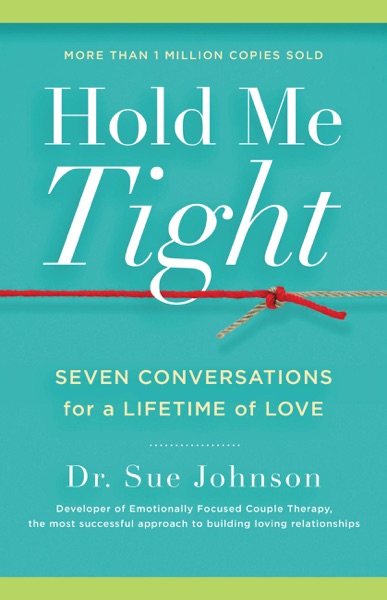
Talk to Hold Me Tight: Seven Conversations for a Lifetime of Love like its author wrote you back.
Get the ideas that fit your life — not generic summaries.
- Chat with the book
- Audiobook-style main ideas
- Adapts to your life and goals
- Helps you take action
Hold Me Tight: Seven Conversations for a Lifetime of Love, in detail
Hold Me Tight is Sue Johnson's accessible introduction to Emotionally Focused Therapy (EFT), a model of couples therapy she developed over decades of clinical practice and research. Published in 2008, the book presents Johnson's central argument: that adult romantic relationships are, at their core, attachment relationships — bonds of security and care whose disruption triggers the same primal fear of abandonment that infants experience. Most relationship conflict, Johnson argues, is not about the content of the fight but about the underlying question of emotional accessibility: "Are you there for me? Do I matter to you?"
Johnson structures the book around seven conversations — specific types of dialogue — that she sees as characteristic of healthy, secure attachment between partners. The conversations move from recognizing the destructive cycles that trap couples (the demand-withdraw pattern, the mutual freeze) through finding the underlying attachment fears that drive those cycles, to building a new kind of emotional responsiveness. Johnson calls the goal of this process "A.R.E." — Accessible, Responsive, and Engaged — and argues that relationships built on this foundation are what she calls "love as a safe haven."
The clinical examples throughout the book are drawn from Johnson's practice and are vivid and specific. They show couples in the middle of familiar conflicts — arguments about sex, chores, work schedules, parenting — and then track how those arguments are actually about something deeper: fear of rejection, fear of not being enough, fear of losing the relationship. The EFT framework reframes these as attachment signals — cries for connection that have been learned to be expressed indirectly or aggressively — and the therapy consists of teaching couples to recognize and respond to them directly.
Hold Me Tight is not a self-help book in the ordinary sense — it is not a list of communication tips or conflict resolution techniques. It is an argument about what love is: not a feeling that comes and goes, but a bond that requires active maintenance, especially in moments of distress. The book draws on attachment theory, neuroscience, and decades of outcome research showing that EFT is among the most empirically supported couples therapy approaches. Readers who find the attachment framework convincing will find it genuinely useful; those who experience their relationship difficulties primarily as communication deficits may find EFT's emphasis on emotional bonding feels less directly applicable.
The big ideas
- 1.
Adult romantic love is an attachment relationship. The fundamental question in relationship conflict is not 'who is right' but 'are you accessible and responsive when I need you?'
- 2.
Most couples get trapped in predictable negative cycles — demand-withdraw, mutual freeze — that escalate the attachment fears driving them rather than resolving them.
- 3.
Underneath most couple arguments is an underlying attachment fear: fear of rejection, abandonment, or not mattering. Addressing the content of the argument without the underlying emotion rarely produces lasting change.
