Hold Me Tight: Seven Conversations for a Lifetime of Love by Sue Johnson is a 2008 psychology book about attachment, relationships, emotional bonding. Adult romantic love is an attachment relationship. The fundamental question in relationship conflict is not 'who is right' but 'are you accessible and responsive when I need you?'
Summary
Hold Me Tight is Sue Johnson's accessible introduction to Emotionally Focused Therapy (EFT), a model of couples therapy she developed over decades of clinical practice and research. Published in 2008, the book presents Johnson's central argument: that adult romantic relationships are, at their core, attachment relationships — bonds of security and care whose disruption triggers the same primal fear of abandonment that infants experience. Most relationship conflict, Johnson argues, is not about the content of the fight but about the underlying question of emotional accessibility: "Are you there for me? Do I matter to you?"
Johnson structures the book around seven conversations — specific types of dialogue — that she sees as characteristic of healthy, secure attachment between partners. The conversations move from recognizing the destructive cycles that trap couples (the demand-withdraw pattern, the mutual freeze) through finding the underlying attachment fears that drive those cycles, to building a new kind of emotional responsiveness. Johnson calls the goal of this process "A.R.E." — Accessible, Responsive, and Engaged — and argues that relationships built on this foundation are what she calls "love as a safe haven."
The clinical examples throughout the book are drawn from Johnson's practice and are vivid and specific. They show couples in the middle of familiar conflicts — arguments about sex, chores, work schedules, parenting — and then track how those arguments are actually about something deeper: fear of rejection, fear of not being enough, fear of losing the relationship. The EFT framework reframes these as attachment signals — cries for connection that have been learned to be expressed indirectly or aggressively — and the therapy consists of teaching couples to recognize and respond to them directly.
Hold Me Tight is not a self-help book in the ordinary sense — it is not a list of communication tips or conflict resolution techniques. It is an argument about what love is: not a feeling that comes and goes, but a bond that requires active maintenance, especially in moments of distress. The book draws on attachment theory, neuroscience, and decades of outcome research showing that EFT is among the most empirically supported couples therapy approaches. Readers who find the attachment framework convincing will find it genuinely useful; those who experience their relationship difficulties primarily as communication deficits may find EFT's emphasis on emotional bonding feels less directly applicable.
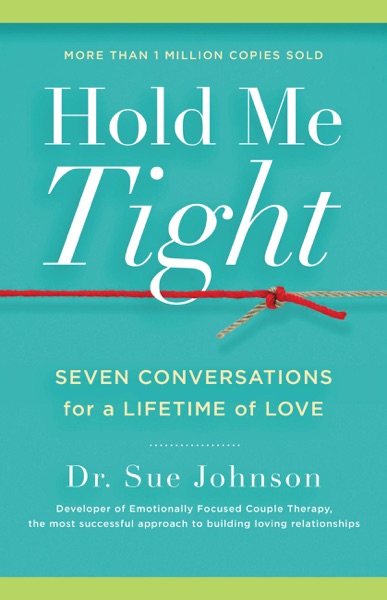
Talk to Hold Me Tight: Seven Conversations for a Lifetime of Love like its author wrote you back.
Get the ideas that fit your life — not generic summaries.
- Chat with the book
- Audiobook-style main ideas
- Adapts to your life and goals
- Helps you take action
Key takeaways
- 1.
Adult romantic love is an attachment relationship. The fundamental question in relationship conflict is not 'who is right' but 'are you accessible and responsive when I need you?'
- 2.
Most couples get trapped in predictable negative cycles — demand-withdraw, mutual freeze — that escalate the attachment fears driving them rather than resolving them.
- 3.
Underneath most couple arguments is an underlying attachment fear: fear of rejection, abandonment, or not mattering. Addressing the content of the argument without the underlying emotion rarely produces lasting change.
- 4.
Emotionally Focused Therapy is one of the most empirically validated approaches to couples work, with decades of outcome research showing measurable improvements in relationship satisfaction and stability.
- 5.
A.R.E. — Accessible, Responsive, and Engaged — describes what a securely attached partner provides. It is a simple framework for checking the quality of emotional presence in a relationship.
- 6.
Attachment needs are not weakness or dependency. Johnson argues, drawing on evolutionary psychology and neuroscience, that they are adaptive and healthy — the need for a safe haven is wired in.
- 7.
Relationship repair after disconnection is possible and actually strengthens secure attachment, provided the repair is genuine and emotionally responsive rather than performative.
- 8.
Sex in long-term relationships is strongly connected to emotional safety. Physical intimacy tends to deteriorate not because desire fades but because the emotional bond that supports it is not being maintained.
Discussion questions
Use these on your own, with a book club, or as chat starters in Superbook. Book club version, ready to copy or print →
- 1.
Johnson argues that most couple conflicts are really about attachment security — the underlying question of whether you are accessible and responsive to your partner. Does this match your experience of relationship arguments?
- 2.
The demand-withdraw cycle — where one partner pursues and the other distances — is one of the most common patterns Johnson describes. Which role have you played, and what do you think drives your position in that cycle?
- 3.
Johnson says attachment needs are healthy and adaptive, not signs of emotional weakness. How comfortable are you with expressing attachment needs directly? What makes it hard?
- 4.
The EFT framework focuses on emotional bonding rather than communication skills or conflict resolution techniques. Do you think better emotional attunement or better communication would make more difference in a relationship you care about?
- 5.
What would it mean for a partner to be A.R.E. — Accessible, Responsive, and Engaged — in your relationship? Are there moments when you feel this strongly, and others when you don't?
- 6.
Johnson argues that sex in long-term relationships is more about emotional safety than physical desire. Does this framing match your experience, or does it feel incomplete?
- 7.
The book draws heavily on clinical examples from Johnson's therapy practice. How much does reading other couples' conflicts help you see patterns in your own, and what are the limits of that approach?
- 8.
Hold Me Tight was written primarily for heterosexual couples. Does the attachment framework it offers seem equally applicable to same-sex relationships and to other relationship structures?
- 9.
Johnson argues that secure attachment in adulthood is not determined by childhood attachment history — it can be built and rebuilt. How convincing do you find this claim?
- 10.
What is the relationship between the kind of emotional attunement Johnson describes in romantic relationships and what you experienced in your family of origin?
- 11.
Johnson says relationship repair after rupture can actually strengthen the bond if done genuinely. Have you experienced this? What made the repair effective?
- 12.
The book is partly a popular account of decades of EFT research. How much does the empirical backing change how you evaluate the practical advice compared to self-help books without that foundation?
Themes
Frequently asked questions
-
What is Hold Me Tight about?
Sue Johnson's argument that adult romantic love is an attachment relationship — governed by the same emotional bonds that connect parents and infants — and that most couple conflict is really about the underlying question of emotional accessibility and responsiveness. The book introduces EFT through seven conversations designed to build secure attachment.
-
Do I need to be in couples therapy to use this book?
No. Johnson wrote it explicitly for couples to use without a therapist, though she recommends professional support for serious distress. Each of the seven conversations includes exercises that couples can work through together. Some couples find reading it and discussing it sufficient; others use it as a preparation for or complement to therapy.
-
How is Hold Me Tight different from other relationship books?
Most relationship books focus on communication skills, conflict resolution, or behavioral change. Hold Me Tight focuses on emotional bonding and attachment — the felt sense of security and responsiveness between partners. This makes it more useful for relationships where communication is intact but emotional connection has eroded.
-
Is EFT evidence-based?
Yes. EFT has been studied in multiple randomized controlled trials and has among the strongest outcome research of any couples therapy approach, with studies showing significant improvements in relationship satisfaction and stability. Johnson discusses this research in the book, though the primary audience is general readers, not clinicians.
-
Who should read Hold Me Tight?
Couples experiencing emotional disconnection, recurring conflict, or the sense that arguments don't resolve but repeat. Also useful for individuals who want to understand their own attachment patterns, for therapists interested in the EFT framework, and for anyone who finds the communication-tips approach to relationship advice feels like it misses something important.
Similar books
The Body Keeps the Score
Bessel van der Kolk
Adult Children of Alcoholics
Janet G. Woititz
A General Theory of Love
Thomas Lewis, Fari Amini, and Richard Lannon
Quiet: The Power of Introverts in a World That Can't Stop Talking
Susan Cain
