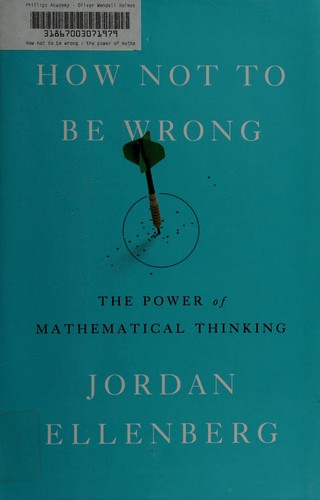
Talk to How Not to Be Wrong: The Power of Mathematical Thinking like its author wrote you back.
Get the ideas that fit your life — not generic summaries.
- Chat with the book
- Audiobook-style main ideas
- Adapts to your life and goals
- Helps you take action
How Not to Be Wrong: The Power of Mathematical Thinking, in detail
Jordan Ellenberg is a research mathematician who writes as if mathematics is something you would want to think about over dinner. This book is his argument that mathematical thinking — not calculus or algebra, but the underlying habits of reasoning that mathematics trains — is one of the most powerful tools available for navigating ordinary life. The title is deliberately modest. Ellenberg isn't promising to make you right; he's promising to make you less systematically wrong.
The book ranges across a dozen mathematical ideas: the geometry of straight lines and why linear models mislead us, the expected value of lotteries and why people consistently play them wrong, the properties of regression to the mean and how they produce false impressions of causation, the mathematics of voting and why no voting system can satisfy all reasonable criteria simultaneously, and the logic of hypothesis testing and why most published findings are statistically weaker than they appear. Each topic is developed through stories rather than formulas, from the U.S. lottery that was briefly profitable to Abraham Wald's famous analysis of where to armor bullet-damaged planes.
Ellenberg's gift is making ideas feel inevitable once explained. The survivor bias story — Wald's insight that you should armor the parts of planes that weren't damaged, because those planes didn't come back — is the kind of revelation that rearranges how you see things. The same goes for his treatment of regression to the mean, which explains why performance seems to decline after praise and improve after criticism, even when praise and criticism have no effect at all. These aren't tricks. They're examples of what careful mathematical reasoning looks like when applied to messy reality.
The book doesn't require a strong math background, but it does require patience with ideas that resist summarization. Ellenberg writes with warmth and self-deprecating humor, but the book rewards readers who slow down for the arguments rather than skimming for conclusions. It's not a collection of mental models you can paste into a framework. It's closer to a long, pleasurable seminar in how to think more carefully, delivered by someone who clearly loves the subject.
The big ideas
- 1.
Linear reasoning fails outside its range. Many phenomena are linear locally but curve dramatically at the extremes, and applying a linear model past its valid range produces absurd predictions.
- 2.
Survivor bias distorts nearly every domain where you only observe what succeeded. Abraham Wald's plane-armor analysis is the classic case, and the pattern appears everywhere from investment funds to startup advice.
- 3.
Regression to the mean is automatic and impersonal. Extreme performances tend to be followed by more average ones regardless of what you did between them — which produces false impressions of causation.
