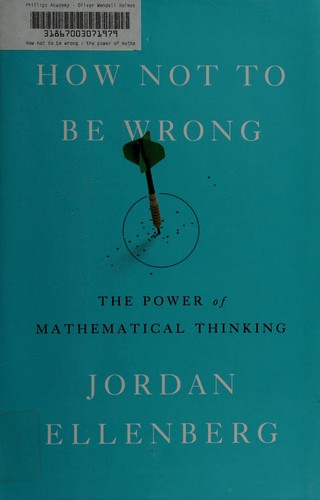
How Not to Be Wrong: The Power of Mathematical Thinking by Jordan Ellenberg is a 2014 science book about mathematics, logic, probability. Linear reasoning fails outside its range. Many phenomena are linear locally but curve dramatically at the extremes, and applying a linear model past its valid range produces absurd predictions.
Summary
Jordan Ellenberg is a research mathematician who writes as if mathematics is something you would want to think about over dinner. This book is his argument that mathematical thinking — not calculus or algebra, but the underlying habits of reasoning that mathematics trains — is one of the most powerful tools available for navigating ordinary life. The title is deliberately modest. Ellenberg isn't promising to make you right; he's promising to make you less systematically wrong.
The book ranges across a dozen mathematical ideas: the geometry of straight lines and why linear models mislead us, the expected value of lotteries and why people consistently play them wrong, the properties of regression to the mean and how they produce false impressions of causation, the mathematics of voting and why no voting system can satisfy all reasonable criteria simultaneously, and the logic of hypothesis testing and why most published findings are statistically weaker than they appear. Each topic is developed through stories rather than formulas, from the U.S. lottery that was briefly profitable to Abraham Wald's famous analysis of where to armor bullet-damaged planes.
Ellenberg's gift is making ideas feel inevitable once explained. The survivor bias story — Wald's insight that you should armor the parts of planes that weren't damaged, because those planes didn't come back — is the kind of revelation that rearranges how you see things. The same goes for his treatment of regression to the mean, which explains why performance seems to decline after praise and improve after criticism, even when praise and criticism have no effect at all. These aren't tricks. They're examples of what careful mathematical reasoning looks like when applied to messy reality.
The book doesn't require a strong math background, but it does require patience with ideas that resist summarization. Ellenberg writes with warmth and self-deprecating humor, but the book rewards readers who slow down for the arguments rather than skimming for conclusions. It's not a collection of mental models you can paste into a framework. It's closer to a long, pleasurable seminar in how to think more carefully, delivered by someone who clearly loves the subject.
Talk to How Not to Be Wrong: The Power of Mathematical Thinking like its author wrote you back.
Get the ideas that fit your life — not generic summaries.
- Chat with the book
- Audiobook-style main ideas
- Adapts to your life and goals
- Helps you take action
Key takeaways
- 1.
Linear reasoning fails outside its range. Many phenomena are linear locally but curve dramatically at the extremes, and applying a linear model past its valid range produces absurd predictions.
- 2.
Survivor bias distorts nearly every domain where you only observe what succeeded. Abraham Wald's plane-armor analysis is the classic case, and the pattern appears everywhere from investment funds to startup advice.
- 3.
Regression to the mean is automatic and impersonal. Extreme performances tend to be followed by more average ones regardless of what you did between them — which produces false impressions of causation.
- 4.
Expected value calculation forces you to account for probability and magnitude together. Most intuitive decisions ignore one or the other.
- 5.
No voting system can satisfy all reasonable fairness criteria simultaneously. Arrow's impossibility theorem is a proven mathematical result, not a preference.
- 6.
A statistically significant result is not necessarily a practically important one. P-values measure improbability under the null hypothesis, not effect size or real-world relevance.
- 7.
Most people misread correlation as causation because the alternative — that two things are correlated without one causing the other — requires a more complex story to tell.
- 8.
Mathematical intuition is trainable. The point of learning to reason carefully about simple cases is to develop habits that generalize to complicated ones.
Discussion questions
Use these on your own, with a book club, or as chat starters in Superbook. Book club version, ready to copy or print →
- 1.
Ellenberg argues that mathematical thinking is a practical tool, not an academic specialty. Where in your own decisions do you notice you're reasoning in a linear or proportional way when the real relationship isn't linear?
- 2.
The survivor bias chapter is about planes, but the principle applies to financial advice, medical treatments, and career decisions. Where in your own field do you primarily see the successes?
- 3.
Regression to the mean produces false impressions that coaching, praise, or criticism caused a change. Where in your experience have you credited an intervention that was probably just regression?
- 4.
Ellenberg shows that expected value and utility don't always align — sometimes a lower expected-value choice is rational because of how the downside feels. Where do you find yourself making that tradeoff deliberately?
- 5.
Arrow's impossibility theorem says every voting system has a flaw. Does that argument change how you think about political systems or committee decisions?
- 6.
The book's treatment of p-values suggests that published science is systematically less reliable than it appears. How much has that changed how you read science journalism?
- 7.
Ellenberg distinguishes between null hypothesis significance testing and actually estimating the size of an effect. Where in your professional life are you measuring significance when you should be measuring magnitude?
- 8.
What's a belief you hold where you think you're reasoning mathematically but might actually be doing something more like motivated pattern-matching?
- 9.
Ellenberg writes about the lotteries where careful mathematical analysis revealed a profitable edge. What does it say that these systems persisted for years before being exploited?
- 10.
The book implies that most errors in public debate come from applying correct reasoning past its range of validity. Can you think of a current example where that's happening?
- 11.
If mathematical thinking is learnable, why isn't it better taught? What would change about how you were educated if this book's perspective were taken seriously?
- 12.
Ellenberg says mathematics is the science of not being wrong. What would it mean to apply that standard to a decision you're currently facing?
Themes
Frequently asked questions
-
Is How Not to Be Wrong worth reading for non-mathematicians?
Yes, and it's probably more valuable for non-mathematicians than for math professionals. Ellenberg writes for readers who don't solve equations but do make decisions under uncertainty. The payoff is a set of reasoning habits that transfer directly to everyday and professional life.
-
How long does it take to read How Not to Be Wrong?
Around seven to eight hours for the roughly 450-page book. It reads faster than many books of similar length because Ellenberg's prose is engaging, but the central arguments deserve slow reading. The book rewards re-reading individual chapters.
-
What mathematical knowledge do I need to read this book?
None beyond high school level, and even that isn't really required. Ellenberg almost never asks readers to calculate anything. The point is to follow arguments, not perform computations. The most demanding sections are on voting theory and expected value, and both are explained from first principles.
-
How does this compare to other popular math books?
It's more argumentative and less survey-oriented than books like A Beautiful Mind or The Man Who Knew Infinity, which are biographical. It covers more ground than The Signal and the Noise while being less domain-specific. The closest comparison is probably Steven Strogatz's work, which shares the tone of a professor who genuinely wants you to enjoy the ideas.
-
What is the most practically useful idea in the book?
The survivor bias chapter, probably. Once you internalize that you systematically see only the outcomes that made it to visibility, you start asking 'what didn't make it back?' in almost every domain — and that question changes what you conclude from examples and case studies.
Similar books
Thinking, Fast and Slow
Daniel Kahneman
The Signal and the Noise
Nate Silver
The Art of Statistics: How to Learn from Data
David Spiegelhalter
Algorithms to Live By: The Computer Science of Human Decisions
Brian Christian and Tom Griffiths
