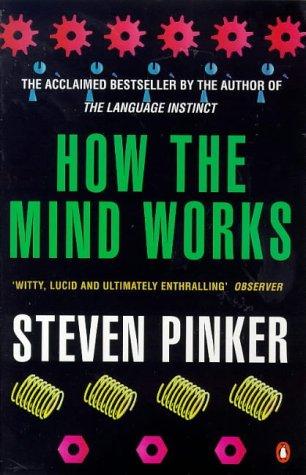
Talk to How the Mind Works like its author wrote you back.
Get the ideas that fit your life — not generic summaries.
- Chat with the book
- Audiobook-style main ideas
- Adapts to your life and goals
- Helps you take action
What it argues
How the Mind Works is Steven Pinker's synthesis of cognitive science and evolutionary psychology, built around a central thesis: the mind is a computational system — a neural computer — shaped by natural selection to solve the adaptive problems that faced our ancestors on the Pleistocene savanna. The book covers vision, reasoning, emotion, social behavior, and consciousness through a single integrating framework: what function did this capacity serve for reproduction and survival, and what computational machinery implements it?
The framework Pinker applies is that of the computational theory of mind, developed by philosophers like Jerry Fodor and computer scientists like Marvin Minsky: mental processes are information processing, describable in terms of inputs, outputs, and computational operations on representations. Pinker combines this computational framework with the adaptationist program of evolutionary biology: the specific computations the brain performs are the ones that were adaptive for our ancestors, not the ones that are optimal in general or that are optimal for us now.
What it gets right
- 1.
The mind is a computational system shaped by natural selection: its specific operations reflect the adaptive problems that faced our ancestors, not general optimization for any current purpose.
- 2.
Vision is active inference, not passive recording: the brain uses prior knowledge and top-down predictions to construct a three-dimensional world from ambiguous two-dimensional retinal signals.
- 3.
Visual illusions reveal the assumptions built into perception — assumptions about lighting, texture, depth — and show that these assumptions are generally correct in the ancestral environment even when they fail in artificial conditions.
What it covers
Who wrote it
Steven Pinker is the Johnstone Family Professor of Psychology at Harvard University and one of the most prominent cognitive scientists and science writers of his generation. His books include The Language Instinct, The Blank Slate, The Better Angels of Our Nature, Enlightenment Now, and Rationality. He received his doctorate from Harvard and taught at MIT before moving to Harvard. How the Mind Works was a finalist for the Pulitzer Prize and the National Book Award in 1997. Pinker is known for defending the evolutionary and computational frameworks against critics in both science and the humanities.
