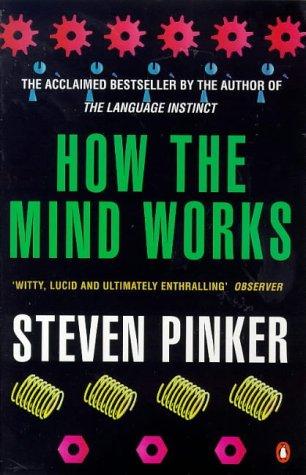
How the Mind Works by Steven Pinker is a 1997 science book about cognition, evolutionary psychology, perception. The mind is a computational system shaped by natural selection: its specific operations reflect the adaptive problems that faced our ancestors, not general optimization for any current purpose.
Summary
How the Mind Works is Steven Pinker's synthesis of cognitive science and evolutionary psychology, built around a central thesis: the mind is a computational system — a neural computer — shaped by natural selection to solve the adaptive problems that faced our ancestors on the Pleistocene savanna. The book covers vision, reasoning, emotion, social behavior, and consciousness through a single integrating framework: what function did this capacity serve for reproduction and survival, and what computational machinery implements it?
The framework Pinker applies is that of the computational theory of mind, developed by philosophers like Jerry Fodor and computer scientists like Marvin Minsky: mental processes are information processing, describable in terms of inputs, outputs, and computational operations on representations. Pinker combines this computational framework with the adaptationist program of evolutionary biology: the specific computations the brain performs are the ones that were adaptive for our ancestors, not the ones that are optimal in general or that are optimal for us now.
The vision chapters are among the best in the book. Pinker explains the problem of vision — how the brain infers a three-dimensional world from the two-dimensional patterns of light on the retina — with remarkable clarity, and uses visual illusions to show that perception is not passive recording but active inference about a world the brain predicts and constructs. The chapters on social cognition — kinship detection, dominance hierarchies, reputation, sexual competition — draw on evolutionary psychology research and are more contentious, though Pinker handles the evidence carefully.
The book ends with a long chapter on the "hard problem" of consciousness — why there is subjective experience at all, not just information processing — where Pinker is unusually candid about what the computational framework cannot explain. He suggests that consciousness may be an adaptation for certain kinds of self-modeling but acknowledges that this does not resolve the philosophical puzzle of why there is something it is like to be a conscious organism. That honesty about the limits of his own framework is one of the book's intellectual strengths.
Talk to How the Mind Works like its author wrote you back.
Get the ideas that fit your life — not generic summaries.
- Chat with the book
- Audiobook-style main ideas
- Adapts to your life and goals
- Helps you take action
Key takeaways
- 1.
The mind is a computational system shaped by natural selection: its specific operations reflect the adaptive problems that faced our ancestors, not general optimization for any current purpose.
- 2.
Vision is active inference, not passive recording: the brain uses prior knowledge and top-down predictions to construct a three-dimensional world from ambiguous two-dimensional retinal signals.
- 3.
Visual illusions reveal the assumptions built into perception — assumptions about lighting, texture, depth — and show that these assumptions are generally correct in the ancestral environment even when they fail in artificial conditions.
- 4.
Evolutionary psychology provides hypotheses about universal aspects of human psychology — kinship detection, social status tracking, mate preference — that can be tested cross-culturally.
- 5.
The computational theory of mind holds that thinking is information processing: mental operations are computations on representations, whether or not the underlying physical substrate is biological neurons or silicon.
- 6.
Emotions are adaptations that efficiently coordinate responses to recurrent adaptive challenges: fear mobilizes for threats, desire motivates approach, disgust avoids contamination, love motivates investment in kin and mates.
- 7.
Social reasoning draws on specialized modules rather than general intelligence: people are much better at detecting cheaters in social contracts than at solving logically equivalent abstract problems.
- 8.
The hard problem of consciousness — why there is subjective experience, not just information processing — remains genuinely unsolved, and Pinker acknowledges that computational theories of mind do not resolve it.
Discussion questions
Use these on your own, with a book club, or as chat starters in Superbook. Book club version, ready to copy or print →
- 1.
Pinker's central claim is that the mind is a computational system shaped by natural selection. Does that framing change how you think about your own mental life?
- 2.
The visual illusion examples show that perception is active inference rather than recording. Had you thought about perception that way before? Does it change anything practically?
- 3.
He argues that many aspects of social behavior are evolutionary adaptations: status seeking, jealousy, coalition formation. Does that evolutionary explanation reduce or enrich your understanding of those behaviors?
- 4.
The Wason selection task shows people are much better at detecting cheating than at solving logically identical abstract problems. What does that suggest about the nature of human rationality?
- 5.
Evolutionary psychology is controversial because it infers ancient adaptive function from current behavior. What are the strongest objections to that methodology?
- 6.
Pinker devotes a chapter to the hard problem of consciousness and admits it is unsolved. Does that admission strengthen or weaken the book's overall case?
- 7.
How do you feel about the idea that emotions are adaptations — computational programs for managing recurrent adaptive challenges? Does that framing honor or diminish the importance of emotional experience?
- 8.
The book is very long and covers an enormous range of topics. Did the breadth feel like a strength or a limitation?
- 9.
Pinker argues that the mind has specialized modules for different domains rather than a single general intelligence. Is there evidence from your own experience for that modularity?
- 10.
He discusses gender differences in cognition and social behavior from an evolutionary perspective. How do you evaluate those claims given how contested they are?
- 11.
If the mind is a neural computer, what does that imply about the possibility of artificial intelligence that genuinely thinks rather than just computes?
- 12.
Which specific claim in the book do you find most contentious, and what evidence would change your mind?
Themes
Frequently asked questions
-
Is How the Mind Works still the best introduction to cognitive science?
It is still a superb introduction but is long. Newer books like Daniel Kahneman's Thinking, Fast and Slow cover some of the same ground in less space. Pinker's book is more comprehensive on the evolutionary foundations and the visual system.
-
Do I need background in psychology or computer science?
No. Pinker explains all concepts from scratch. The computational and evolutionary frameworks are introduced early and applied throughout. General readers with patience for a long book will find it accessible.
-
Is evolutionary psychology still a respectable field?
Yes, though its methodology is debated. The critiques focus on how evolutionary explanations are tested and whether the 'ancestral environment' is well enough specified. Pinker is aware of these critiques and addresses them, though critics argue not adequately.
-
What is the hard problem of consciousness?
The question of why there is subjective experience — why it feels like something to see red or feel pain — rather than just information processing that happens in the dark. Computational theories can explain how information is processed but not why that processing is accompanied by experience.
-
What is the most important chapter?
The visual perception chapter for scientific insight, and the consciousness chapter for intellectual honesty. The vision section explains active perception better than almost anything else in popular science; the consciousness chapter is one of the few places where Pinker admits a clear limit to his framework.
Similar books
The Language Instinct
Steven Pinker

The Better Angels of Our Nature
Steven Pinker

The Righteous Mind: Why Good People Are Divided by Politics and Religion
Jonathan Haidt
Thinking, Fast and Slow
Daniel Kahneman
