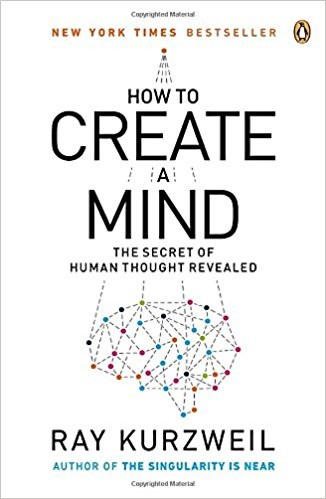
Talk to How to Create a Mind like its author wrote you back.
Get the ideas that fit your life — not generic summaries.
- Chat with the book
- Audiobook-style main ideas
- Adapts to your life and goals
- Helps you take action
What it argues
Ray Kurzweil's central claim in How to Create a Mind is that the neocortex — the part of the brain responsible for higher thought — operates on a single repeating algorithm called the pattern recognition theory of mind. If that theory is correct, and if the neocortex can be modeled hierarchically as a system of roughly 300 million pattern recognizers arranged in a self-organizing hierarchy, then in principle the brain can be reverse-engineered and its key functions replicated in silicon. Kurzweil published this book in 2012, when he was about to join Google to direct AI research, and it reads as both a neuroscientific argument and a manifesto for where artificial intelligence is headed.
The first half of the book builds the biological case. Kurzweil draws on neuroscience research to argue that the neocortex processes information through a six-layer hierarchy of pattern-recognizing modules, each learning to recognize patterns in the output of the layer below it. He compares this to deep learning architectures — not coincidentally, since the same hierarchical structure underlies the neural networks that were beginning to transform machine learning. The analogy between biological neural architecture and artificial neural networks is the book's core intellectual move.
What it gets right
- 1.
The pattern recognition theory of mind proposes that the neocortex operates via roughly 300 million hierarchically organized pattern recognizers, each learning to respond to patterns in its input from lower layers.
- 2.
Deep learning architectures mirror the hierarchical structure of the neocortex — this convergence between brain science and machine learning is not coincidental but reflects a shared computational strategy.
- 3.
Exponential growth in computing power means AI capability is not growing linearly. Kurzweil's forecasts are based on the assumption that this exponential trajectory will continue.
What it covers
Who wrote it
Ray Kurzweil is an American inventor, futurist, and author. He has been a principal developer of optical character recognition, text-to-speech synthesis, and speech recognition technology. His earlier books include The Age of Intelligent Machines and The Singularity Is Near. In 2012, the year How to Create a Mind was published, he joined Google as director of engineering focused on natural language understanding. He holds honorary degrees from numerous universities and has received the National Medal of Technology, among other awards.
