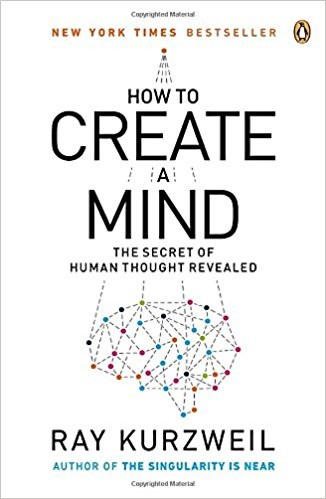
How to Create a Mind by Ray Kurzweil is a 2012 science book about artificial intelligence, neuroscience, pattern recognition. The pattern recognition theory of mind proposes that the neocortex operates via roughly 300 million hierarchically organized pattern recognizers, each learning to respond to patterns in its input from lower layers.
Summary
Ray Kurzweil's central claim in How to Create a Mind is that the neocortex — the part of the brain responsible for higher thought — operates on a single repeating algorithm called the pattern recognition theory of mind. If that theory is correct, and if the neocortex can be modeled hierarchically as a system of roughly 300 million pattern recognizers arranged in a self-organizing hierarchy, then in principle the brain can be reverse-engineered and its key functions replicated in silicon. Kurzweil published this book in 2012, when he was about to join Google to direct AI research, and it reads as both a neuroscientific argument and a manifesto for where artificial intelligence is headed.
The first half of the book builds the biological case. Kurzweil draws on neuroscience research to argue that the neocortex processes information through a six-layer hierarchy of pattern-recognizing modules, each learning to recognize patterns in the output of the layer below it. He compares this to deep learning architectures — not coincidentally, since the same hierarchical structure underlies the neural networks that were beginning to transform machine learning. The analogy between biological neural architecture and artificial neural networks is the book's core intellectual move.
The second half shifts to implications. Kurzweil argues that brain-inspired AI will soon match and then exceed human cognitive capability, and that the exponential improvement in computational power makes this a question of when, not whether. He addresses consciousness, the hard problem of subjective experience, and whether a machine that passes the Turing Test could be said to feel. His answers are characteristically confident and the philosophy is uncharacteristically light for the questions involved.
Readers who are skeptical of Kurzweil's broader singularity thesis will find the neuroscience and AI chapters more durable than the forecasting. The book is best read as a technically substantive case for deep learning's biological plausibility rather than as a reliable timeline for the future of machine intelligence. The two are separable, and the former is considerably better argued.
Talk to How to Create a Mind like its author wrote you back.
Get the ideas that fit your life — not generic summaries.
- Chat with the book
- Audiobook-style main ideas
- Adapts to your life and goals
- Helps you take action
Key takeaways
- 1.
The pattern recognition theory of mind proposes that the neocortex operates via roughly 300 million hierarchically organized pattern recognizers, each learning to respond to patterns in its input from lower layers.
- 2.
Deep learning architectures mirror the hierarchical structure of the neocortex — this convergence between brain science and machine learning is not coincidental but reflects a shared computational strategy.
- 3.
Exponential growth in computing power means AI capability is not growing linearly. Kurzweil's forecasts are based on the assumption that this exponential trajectory will continue.
- 4.
Reverse-engineering the brain does not require replicating its every neuron — it requires understanding the algorithms that produce intelligent behavior and implementing them in a sufficiently powerful medium.
- 5.
The Turing Test measures behavioral indistinguishability from human intelligence, not the presence of consciousness. Kurzweil argues these will eventually converge but the distinction matters philosophically.
- 6.
Language understanding requires hierarchical pattern recognition across multiple levels of abstraction — phonemes, words, grammar, context — and is one of the clearest cases where brain architecture informs AI design.
- 7.
Kurzweil's reading of neuroscience is selective. Critics argue that the brain is considerably messier and more heterogeneous than the uniform neocortical algorithm he describes.
- 8.
The question of whether machines can be conscious is left philosophically unresolved. Kurzweil argues the question dissolves once behavior is indistinguishable, a position most philosophers of mind reject.
Discussion questions
Use these on your own, with a book club, or as chat starters in Superbook. Book club version, ready to copy or print →
- 1.
Kurzweil argues that the neocortex uses a single repeating algorithm. Does the elegance of that claim make you more or less suspicious of it as a complete account of human thought?
- 2.
The book was published in 2012, before the current deep learning revolution. Which of Kurzweil's predictions have since materialized, and which still seem far off?
- 3.
If the human mind is fundamentally a pattern-recognition hierarchy, what follows for questions of free will, creativity, and moral responsibility?
- 4.
Kurzweil treats the Turing Test as the relevant threshold for intelligence. Do you think behavioral indistinguishability is sufficient for attributing consciousness, or is there something more required?
- 5.
The book distinguishes between emulating the brain and understanding it. Does Kurzweil's account feel more like an explanation of the mind or an engineering specification for copying it?
- 6.
Deep learning systems trained on vast datasets now do many of the things Kurzweil predicted. Does their success confirm the book's thesis, or does the way they work differ enough from his model that the confirmation is superficial?
- 7.
Kurzweil is confident that consciousness arises from information processing of sufficient complexity. What do you think is missing from that account, if anything?
- 8.
The book's neuroscience has been criticized by working neuroscientists as oversimplified. How do you weigh an accessible, unified theory against a more accurate but messier picture?
- 9.
If a machine could pass for human in every conversation you had with it, would your behavior toward it change? Should it?
- 10.
Kurzweil's career combines invention, futurism, and business. Does knowing his background affect how you evaluate his scientific claims?
- 11.
The singularity thesis depends on exponential growth continuing indefinitely. What reasons are there to think it might plateau, and what would that imply for Kurzweil's timeline?
- 12.
Reading this in 2026 with the benefit of a decade of AI progress, what is the single most important thing the book got right and the single most important thing it missed?
Themes
Frequently asked questions
-
What is How to Create a Mind about?
It argues that the neocortex operates on a hierarchical pattern-recognition algorithm that can be reverse-engineered and replicated in artificial systems. Kurzweil uses this to ground predictions about the trajectory of artificial intelligence and to address questions about consciousness and machine cognition.
-
Is How to Create a Mind still relevant after the deep learning revolution?
More so than before. The hierarchical pattern-recognition architecture Kurzweil described in 2012 closely resembles the deep learning systems that subsequently transformed AI. His specific timelines are debatable, but the core structural analogy has held up better than many critics expected.
-
Is the neuroscience in the book accurate?
Selectively. Kurzweil draws on real research but presents a more uniform and elegant picture of the neocortex than most neuroscientists would endorse. The brain is messier than his model implies, though the hierarchical principle has genuine support.
-
Do I need a technical background to read it?
No. Kurzweil writes for a general audience and explains technical concepts as he goes. Readers with some background in AI or neuroscience will find it moves faster; those without can still follow the core arguments.
-
How does this compare to The Singularity Is Near?
How to Create a Mind is narrower and more focused — it makes the biological and computational case for a specific theory of the brain rather than surveying the full singularity thesis. It is the more scientifically substantive of the two books.
Similar books
The Master Algorithm
Pedro Domingos
Algorithms to Live By: The Computer Science of Human Decisions
Brian Christian and Tom Griffiths
A Mind for Numbers
Barbara Oakley
Our Mathematical Universe
Max Tegmark
