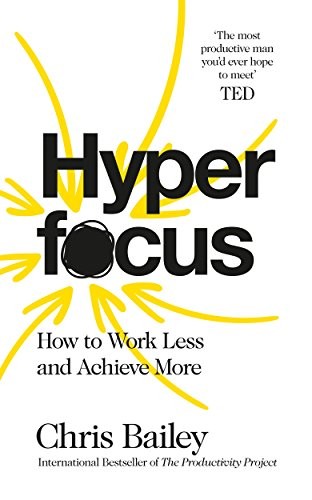
Talk to Hyperfocus like its author wrote you back.
Get the ideas that fit your life — not generic summaries.
- Chat with the book
- Audiobook-style main ideas
- Adapts to your life and goals
- Helps you take action
What it argues
Hyperfocus is Chris Bailey's second book, narrowing in on the attention piece of his earlier productivity triad. The book is built around two distinct modes of attention and the argument that peak productivity requires skillfully cycling between them: hyperfocus, the mode of intense, single-tasking concentration on one demanding task; and scatterfocus, the more diffuse, wandering mode that drives creative insight and problem-solving.
The first half of the book deals with hyperfocus. Bailey's research synthesis shows that our attentional space — the amount of information we can hold and work with at once — is small and easily overwhelmed. When we overstuff it with multiple tasks, notifications, and half-finished thoughts, the quality of everything we're thinking about degrades. Clearing the attentional space to hold only one complex task is the condition for hyperfocus, and Bailey gives practical protocols for creating that condition: choosing one task, managing the environment, setting a clear intention, and recapturing attention when it wanders.
What it gets right
- 1.
Attentional space is limited. Overloading it with multiple tasks, notifications, and background distractions degrades the quality of everything you're thinking about simultaneously.
- 2.
Hyperfocus requires four conditions: choosing one complex task, eliminating distractions, directing full attention to that task, and returning attention to it when it wanders.
- 3.
The most productive people don't focus harder — they choose more carefully what to focus on. Intentional selection of the task is as important as the focus itself.
What it covers
Who wrote it
Chris Bailey is a Canadian productivity author and consultant who spent a year after university running self-experiments on focus, time, and energy. His website A Life of Productivity attracted a large audience before his first book. Hyperfocus, published in 2018, is his second book and focuses specifically on the science of attention. He speaks to companies around the world on productivity and has appeared in publications including the New York Times, Wall Street Journal, and Harvard Business Review. He lives in Ottawa.
