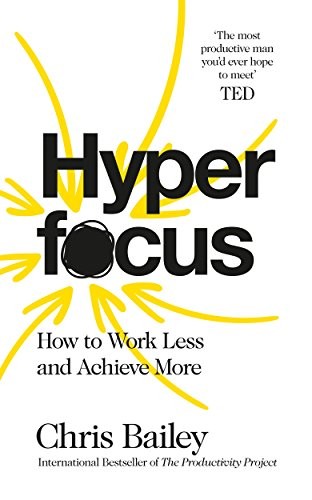
Hyperfocus by Chris Bailey is a 2018 self-help book about focus, attention, productivity. Attentional space is limited. Overloading it with multiple tasks, notifications, and background distractions degrades the quality of everything you're thinking about simultaneously.
Summary
Hyperfocus is Chris Bailey's second book, narrowing in on the attention piece of his earlier productivity triad. The book is built around two distinct modes of attention and the argument that peak productivity requires skillfully cycling between them: hyperfocus, the mode of intense, single-tasking concentration on one demanding task; and scatterfocus, the more diffuse, wandering mode that drives creative insight and problem-solving.
The first half of the book deals with hyperfocus. Bailey's research synthesis shows that our attentional space — the amount of information we can hold and work with at once — is small and easily overwhelmed. When we overstuff it with multiple tasks, notifications, and half-finished thoughts, the quality of everything we're thinking about degrades. Clearing the attentional space to hold only one complex task is the condition for hyperfocus, and Bailey gives practical protocols for creating that condition: choosing one task, managing the environment, setting a clear intention, and recapturing attention when it wanders.
The second half is about scatterfocus: the intentional cultivation of mind-wandering for creativity and insight. Bailey argues that the modern hostility to boredom and idle time has destroyed one of our most valuable cognitive modes. Scatterfocus is when the default mode network — the brain's resting-state activity — makes unexpected connections between disparate ideas. Walking without a podcast, showering without music, sitting without a phone: these are not wasted time but productive conditions for creative thought.
The book closes with strategies for cycling between the two modes intentionally — using hyperfocus for execution and scatterfocus for planning, problem-solving, and creative ideation. Bailey's writing is clear and well-organized, and the book is more research-grounded than most in the genre.
Talk to Hyperfocus like its author wrote you back.
Get the ideas that fit your life — not generic summaries.
- Chat with the book
- Audiobook-style main ideas
- Adapts to your life and goals
- Helps you take action
Key takeaways
- 1.
Attentional space is limited. Overloading it with multiple tasks, notifications, and background distractions degrades the quality of everything you're thinking about simultaneously.
- 2.
Hyperfocus requires four conditions: choosing one complex task, eliminating distractions, directing full attention to that task, and returning attention to it when it wanders.
- 3.
The most productive people don't focus harder — they choose more carefully what to focus on. Intentional selection of the task is as important as the focus itself.
- 4.
Scatterfocus — intentional mind-wandering — is not distraction but a distinct cognitive mode that produces creative insights, problem-solving breakthroughs, and future planning.
- 5.
Eliminating default boredom-filling (phone-checking, background audio, social scrolling) restores access to the scatterfocus mode that generates creative thought.
- 6.
The cost of attention residue is real: switching tasks leaves a residue of the previous task in your working memory that degrades performance on the next for ten to twenty minutes.
- 7.
Your most productive period of the day — your biological prime time — should be protected for complex, high-value work. Maintenance tasks belong in off-peak hours.
- 8.
Setting a single daily intention — what you want to have accomplished by day's end — dramatically increases the probability of doing meaningful work.
Discussion questions
Use these on your own, with a book club, or as chat starters in Superbook. Book club version, ready to copy or print →
- 1.
Bailey argues that attentional space is limited and small. What does your typical working day do to that space — does it leave room for deep thinking, or fill every gap?
- 2.
What is your most reliable trigger for attention fragmentation — the thing that most reliably pulls you away from what you're trying to focus on?
- 3.
Have you ever experienced the scatterfocus insight phenomenon — an unexpected idea appearing during a walk, shower, or drive? What conditions seemed to produce it?
- 4.
How much unscheduled, phone-free time do you have in a typical week? What would you need to change to add two hours of it?
- 5.
Bailey says we've lost tolerance for boredom. When was the last time you sat without filling the silence? What happened?
- 6.
If you had to pick one change to your environment that would most improve your ability to hyperfocus, what would it be?
- 7.
He describes setting a daily intention as a powerful practice. What would your intention be for today, stated in a single sentence?
- 8.
Attention residue means that each task switch costs you ten to twenty minutes of reduced performance. How many times do you switch tasks in a typical morning?
- 9.
What's the creative or strategic problem you're currently trying to solve that you've been approaching only through active, deliberate thinking? What would scatterfocus time with it reveal?
- 10.
Bailey distinguishes attractive distractions from annoying interruptions. Which form of distraction costs you more focus time in a typical day?
- 11.
He argues that most people are living in a permanent state of partial attention. What does your most fully attentive self look like, and when do you last remember being there?
- 12.
If you blocked one hour each day for pure hyperfocus on your most important work, what would you use it for, and what would you have to say no to in order to protect it?
Themes
Frequently asked questions
-
Is Hyperfocus worth reading if I've already read The Productivity Project?
Yes, because it goes deeper on attention specifically, which The Productivity Project covers more broadly. The scatterfocus section in particular adds substantially new material. If you only read one Bailey book, The Productivity Project is broader; if you found the attention chapter most compelling, Hyperfocus is the follow-up.
-
How long does it take to read Hyperfocus?
About four hours at average pace. The chapters are organized cleanly and the book doesn't repeat itself much. It can be read cover to cover or used as a reference for specific attention challenges.
-
What is the main idea of Hyperfocus?
There are two valuable modes of attention: hyperfocus (single-task deep concentration) and scatterfocus (intentional mind-wandering for creativity). Managing both deliberately is the key to both productivity and creative insight.
-
What is scatterfocus and how do I cultivate it?
Scatterfocus is the intentional mind-wandering mode that produces creative insight and future planning. You cultivate it by creating phone-free, stimuli-free time — walks without podcasts, meals without screens, moments of genuine boredom — so the brain's default mode network can make connections.
-
Who should read Hyperfocus?
Knowledge workers who struggle with distraction and feel like they never reach a state of deep engagement with their work. Also useful for people who feel creatively stuck and haven't considered that their lack of idle time might be the cause.