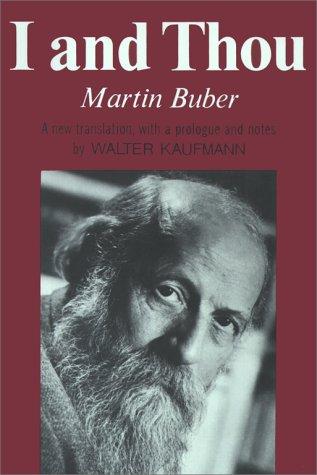
Talk to I and Thou like its author wrote you back.
Get the ideas that fit your life — not generic summaries.
- Chat with the book
- Audiobook-style main ideas
- Adapts to your life and goals
- Helps you take action
What it argues
I and Thou is Martin Buber's central philosophical work, first published in German in 1923. Its argument is built on a distinction between two fundamental ways of being in relation to the world. The "I-Thou" relation is one of genuine encounter, full presence, and mutuality: you meet the other in their irreducible particularity, not as an object to be used, understood, or categorized. The "I-It" relation treats the other — a person, a tree, an idea — as something to be experienced, analyzed, or exploited. Buber's claim is that human life oscillates between these two modes, and that the I-Thou encounters, though they cannot be sustained indefinitely, are what give life its depth.
The book is structured in three parts. The first introduces the I-Thou/I-It distinction through brief, poetic examples — a tree, a cat, a conversation. The second extends the analysis to culture, history, and communities. The third reaches for the eternal Thou: the argument that all genuine I-Thou encounters open toward a divine relation, that God is the Thou that cannot become an It. This last move is the most contested part of the book and will land differently depending on the reader's relationship to religious thought.
What it gets right
- 1.
The world is dual: you can encounter anything — a person, an animal, a work of art — in I-Thou mode (full presence) or I-It mode (observation, use). The mode is a choice, and it shapes what you receive.
- 2.
I-Thou encounters cannot be sustained indefinitely. Every Thou inevitably becomes an It over time — and that isn't failure, it's the structure of lived experience.
- 3.
The I that exists in I-Thou relation is different from the I that exists in I-It relation. You are not the same person in both modes; the relation partly constitutes who you are.
What it covers
Who wrote it
Martin Buber (1878–1965) was an Austrian-born Jewish philosopher and writer whose work spanned religious philosophy, existentialism, political theory, and education. He taught at the University of Frankfurt until the rise of National Socialism, emigrated to Palestine in 1938, and became a professor of social philosophy at Hebrew University, where he remained until retirement. In addition to I and Thou, his major works include Tales of the Hasidim, Moses, and Paths in Utopia. He was twice nominated for the Nobel Prize in Literature and remained an influential figure in interfaith dialogue and humanistic psychology until his death in Jerusalem at eighty-seven.
