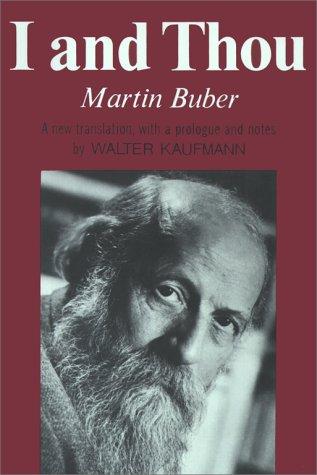
I and Thou by Martin Buber is a 1923 philosophy book about relationality, dialogue, presence. The world is dual: you can encounter anything — a person, an animal, a work of art — in I-Thou mode (full presence) or I-It mode (observation, use). The mode is a choice, and it shapes what you receive.
Summary
I and Thou is Martin Buber's central philosophical work, first published in German in 1923. Its argument is built on a distinction between two fundamental ways of being in relation to the world. The "I-Thou" relation is one of genuine encounter, full presence, and mutuality: you meet the other in their irreducible particularity, not as an object to be used, understood, or categorized. The "I-It" relation treats the other — a person, a tree, an idea — as something to be experienced, analyzed, or exploited. Buber's claim is that human life oscillates between these two modes, and that the I-Thou encounters, though they cannot be sustained indefinitely, are what give life its depth.
The book is structured in three parts. The first introduces the I-Thou/I-It distinction through brief, poetic examples — a tree, a cat, a conversation. The second extends the analysis to culture, history, and communities. The third reaches for the eternal Thou: the argument that all genuine I-Thou encounters open toward a divine relation, that God is the Thou that cannot become an It. This last move is the most contested part of the book and will land differently depending on the reader's relationship to religious thought.
Buber writes in an unusual prose — dense, rhythmic, almost prophetic in places. Walter Kaufmann's 1970 translation into English is generally considered more accurate and less archaic than the earlier Ronald Gregor Smith version, though both have devoted defenders. The style is intentional: Buber wanted the book itself to be an encounter rather than an explanation, and this makes it resist summary. Reading secondary literature alongside the text is useful.
The book's lasting influence has been felt in theology, psychology, education, and social philosophy. Carl Rogers cited Buber's work on genuine encounter in developing person-centered therapy. Educators have drawn on the I-Thou framework to argue that teaching is a relational practice, not an information-transfer problem. The limitation is that the vocabulary — Thou, eternal Thou, the between — can become a way of feeling profound without being precise. Buber's ideas work best when they stay close to concrete experience rather than abstraction.
Talk to I and Thou like its author wrote you back.
Get the ideas that fit your life — not generic summaries.
- Chat with the book
- Audiobook-style main ideas
- Adapts to your life and goals
- Helps you take action
Key takeaways
- 1.
The world is dual: you can encounter anything — a person, an animal, a work of art — in I-Thou mode (full presence) or I-It mode (observation, use). The mode is a choice, and it shapes what you receive.
- 2.
I-Thou encounters cannot be sustained indefinitely. Every Thou inevitably becomes an It over time — and that isn't failure, it's the structure of lived experience.
- 3.
The I that exists in I-Thou relation is different from the I that exists in I-It relation. You are not the same person in both modes; the relation partly constitutes who you are.
- 4.
Buber argues that genuine meeting — real dialogue — requires that both parties be fully present and take the risk of being changed. Most of what passes for conversation is two monologues.
- 5.
The eternal Thou is Buber's term for what genuine human encounters open toward — a ground of being that doesn't become an It. Whether you call this God or not, the concept points to something that many readers recognize.
- 6.
Modern civilization's expansion of I-It relations — treating people as functions, means, or data — is Buber's diagnosis of what alienation actually is.
- 7.
Community, in Buber's view, is not a collective but a set of genuine relations. You cannot have community through organization alone.
- 8.
The 'between' — the space that comes into being in genuine encounter — is not inside either party but belongs to both. Buber calls this the primary reality.
Discussion questions
Use these on your own, with a book club, or as chat starters in Superbook. Book club version, ready to copy or print →
- 1.
Think of a recent conversation where you felt genuinely encountered by another person. What distinguished that from most conversations? What conditions made it possible?
- 2.
Buber says we inevitably reduce Thous to Its over time. Is that always a failure, or is there a way to move between the modes intentionally?
- 3.
What relationships in your life are primarily I-It right now — functional, instrumental, without real presence? What would it mean to shift even one of them toward I-Thou?
- 4.
Buber includes non-human relationships — with trees, animals, works of art — in the I-Thou framework. Do you find that extension convincing, or does it dilute the concept?
- 5.
The third part of the book argues that all genuine encounter opens toward God. Do you need to accept that move to find the rest of the book useful?
- 6.
Buber says modern institutions tend to replace genuine meeting with organization. Where do you see I-It relations masquerading as community in your own life?
- 7.
The 'between' is Buber's name for what arises in genuine encounter that belongs to neither party. Have you experienced something that that word captures?
- 8.
How does Buber's framework change how you think about digital communication — platforms designed to make connection efficient and scalable?
- 9.
Buber's prose is deliberately difficult. Do you think the style serves the argument, or does it create unnecessary mystification?
- 10.
Rogers adapted Buber's ideas in developing person-centered therapy. If a therapist's job is to offer I-Thou encounter, what does that demand of them professionally and personally?
- 11.
Buber distinguishes genuine dialogue from 'technical dialogue' (exchanging information) and 'monologue disguised as dialogue' (talking at each other). Which of these three describes most of the conversations you have at work?
- 12.
Does the idea that the relation partly constitutes the person ring true to your experience? In what ways are you different depending on who you're with?
Themes
Frequently asked questions
-
Is I and Thou difficult to read?
Yes, deliberately so. Buber's prose is poetic and dense, and the book does not argue in the way analytic philosophy does. Readers typically need to sit with individual passages rather than follow a linear argument. The Kaufmann translation (1970) is generally easier to parse than earlier versions, and reading it alongside a commentary helps.
-
What is I and Thou actually about?
The claim that human experience is structured by two fundamentally different modes of relating — I-Thou (genuine encounter, full presence) and I-It (observation, use, analysis) — and that the depth of a life depends on the quality and frequency of genuine meeting. The third part extends this into a philosophy of God.
-
Do I have to be religious to get something from I and Thou?
No. The first two parts of the book stand without the theological third. The observation that most human interaction is I-It rather than I-Thou — functional, managing, categorizing rather than genuinely present — is widely applicable regardless of religious commitments.
-
How does I and Thou relate to therapy and psychology?
Carl Rogers cited it directly in developing person-centered therapy. The idea that genuine healing requires a real encounter — not a technique applied to a patient but a mutual meeting — comes directly from Buber. Therapists across traditions have drawn on the I-Thou concept in thinking about what therapeutic presence actually involves.
-
Who should read I and Thou?
Readers with patience for difficult philosophical writing who want to think carefully about encounter, presence, and what it means to genuinely meet another person. It rewards returning to over time more than it rewards a single read-through.