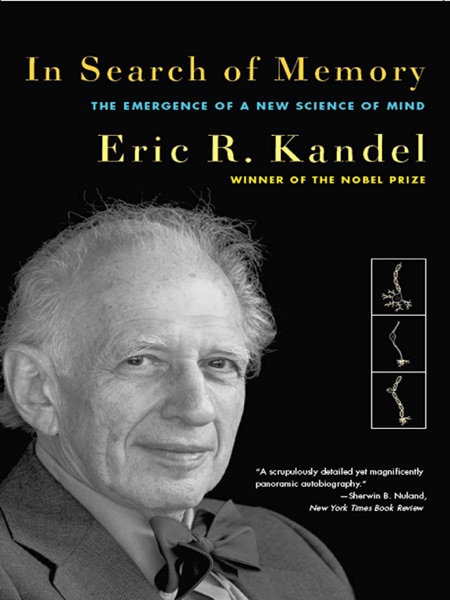
Talk to In Search of Memory like its author wrote you back.
Get the ideas that fit your life — not generic summaries.
- Chat with the book
- Audiobook-style main ideas
- Adapts to your life and goals
- Helps you take action
In Search of Memory, in detail
In Search of Memory is Eric Kandel's autobiography interleaved with the history of neuroscience, organized around his own central scientific achievement: the cellular and molecular mechanisms of memory storage in the sea slug Aplysia. Kandel won the Nobel Prize in Physiology or Medicine in 2000 for this work. The book is his account of how he came to the question of memory, what the science showed, and what it means for our understanding of who we are.
The autobiography begins in Vienna, where Kandel was born into a Jewish family in 1929 and from which his family escaped just before World War II. The experience of Kristallnacht — being expelled from their apartment by a Nazi neighbor while he watched, at the age of nine — became for Kandel a defining puzzle: how could ordinary people become perpetrators of such violence? The question drove an early interest in psychology and psychoanalysis, which he pursued at Harvard before concluding that the reductionist tools of biology offered more tractable paths to understanding the mind.
The scientific chapters trace the logic of Kandel's research program. He chose Aplysia — a sea slug with large, identifiable neurons — precisely because it was simple enough to work with and because the mechanisms of learning and memory in simpler organisms, he bet, would illuminate the same mechanisms in more complex ones. The bet paid off: Kandel's work showed that short-term memory involves changes in synaptic strength, while long-term memory requires gene expression and the growth of new synaptic connections. Memory is biology, not metaphysics.
What makes the book unusual is the integration of the personal and the scientific. The opening story about Vienna is not incidental — it sets up a lifelong inquiry into how experience shapes who we become, and how the brain's capacity to be modified by experience (what neuroscientists call synaptic plasticity) is the physical substrate of that shaping. Kandel returns repeatedly to the question of what the biology of memory means for psychoanalytic concepts, for identity, and for the nature of the self. The book is both a scientific primer and a genuinely moving account of a life shaped by displacement, curiosity, and the good fortune of having found exactly the right question at exactly the right time.
The big ideas
- 1.
Long-term memory requires gene expression and the growth of new synaptic connections, not just changes in synaptic strength. This distinction between short- and long-term memory has profound biological implications.
- 2.
Kandel's choice to work on Aplysia — a simple organism with large, identifiable neurons — exemplifies the reductionist strategy: find the simplest system in which a phenomenon occurs.
- 3.
Synaptic plasticity — the ability of synaptic connections to strengthen or weaken based on activity — is the physical basis of learning and memory in all animals studied so far.
