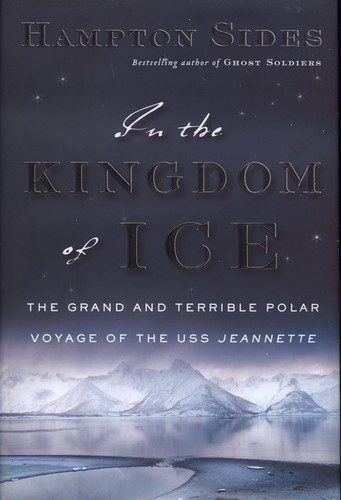
Talk to In the Kingdom of Ice: The Grand and Terrible Polar Voyage of the USS Jeannette like its author wrote you back.
Get the ideas that fit your life — not generic summaries.
- Chat with the book
- Audiobook-style main ideas
- Adapts to your life and goals
- Helps you take action
In the Kingdom of Ice: The Grand and Terrible Polar Voyage of the USS Jeannette, in detail
In 1879, the USS Jeannette sailed from San Francisco into the Arctic under the command of Lieutenant George Washington De Long, on a mission to reach the North Pole. The expedition was backed by newspaper mogul James Gordon Bennett Jr., fueled by the era's romantic belief that a warm open sea lay beyond the polar ice, and crewed by men who knew the odds were not in their favor. Hampton Sides reconstructs what happened to them with the pacing of a thriller and the research depth of serious history.
The ship became trapped in pack ice within weeks of entering Arctic waters. For the next twenty-two months, the Jeannette drifted with the ice, unable to break free, slowly being crushed. Sides traces the daily life aboard the icebound vessel — the boredom, the frostbite, the disciplinary tensions, the scientific observations De Long insisted on keeping — while building a portrait of a captain who held his crew together through sheer force of will and institutional faith in the navy's chain of command.
When the Jeannette finally sank in June 1881, the crew faced a march across the frozen sea toward the Siberian coast, dragging heavy lifeboats. The journey killed most of them. The survivors' eventual rescue — and the discovery of the dead — forms the book's devastating final act. Sides is meticulous about the science of Arctic survival and clear-eyed about the expedition's larger meaning: it was a disaster that also contributed to understanding of Arctic currents and ocean drift in ways that benefited the expeditions that followed.
The book works because Sides resists the temptation to make De Long a hero or a fool. He was a disciplined, earnest officer executing a mission that the state of geographic knowledge in 1879 made plausible. The failure was partly his, partly the era's, and partly the Arctic's. Readers who enjoyed Endurance or Into Thin Air will find the same qualities here: meticulous research, real human stakes, and a landscape that makes ordinary competence insufficient.
The big ideas
- 1.
The belief in an 'open polar sea' beyond the ice was not fringe pseudoscience in 1879 — it was a respectable geographic theory that sent real ships and real men to their deaths.
- 2.
De Long's leadership was defined less by inspiration than by discipline: he maintained naval routines, kept detailed logs, and insisted on scientific observation even as the ship drifted helplessly.
- 3.
Pack ice is not a static obstacle. The Jeannette's drift across the Arctic — invisible at the time — was later recognized as a major discovery about ocean current patterns.
