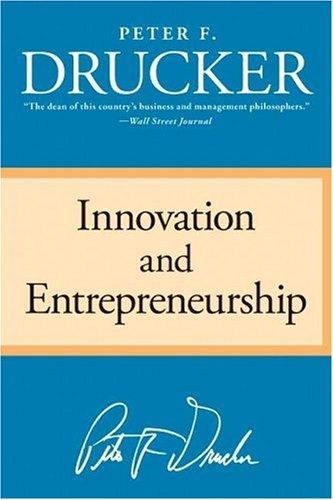
Talk to Innovation and Entrepreneurship like its author wrote you back.
Get the ideas that fit your life — not generic summaries.
- Chat with the book
- Audiobook-style main ideas
- Adapts to your life and goals
- Helps you take action
What it argues
Innovation and Entrepreneurship is Drucker's systematic treatment of a subject that, in 1985, most people still regarded as the province of lone geniuses and lucky accidents. Drucker rejects that picture entirely. For him, innovation is a discipline — a practice that can be analyzed, learned, and managed just as rigorously as accounting or operations.
The book's first half catalogs seven sources of innovative opportunity. Some are internal to a business or industry: unexpected successes or failures, incongruities between what is and what ought to be, process weaknesses, and changes in market or industry structure. Others come from the outside: demographic shifts, changes in perception, and new knowledge. Drucker's argument is that systematically monitoring these sources, rather than waiting for inspiration, is how most successful innovations actually originate. The case studies are drawn from manufacturing, services, hospitals, and government — a breadth that prevents the analysis from feeling narrowly applicable.
What it gets right
- 1.
Innovation is a discipline, not a talent. Systematic scanning of seven specific sources of opportunity produces more innovation than waiting for inspiration.
- 2.
Unexpected success is the most neglected source of innovation. Organizations routinely ignore or dismiss results that don't fit their assumptions.
- 3.
Incongruity — a gap between what is and what ought to be — signals that an assumption underlying the business is wrong and an opportunity exists.
What it covers
Who wrote it
Peter F. Drucker (1909–2005) was an Austrian-American management consultant, educator, and author whose work defined modern management thinking across six decades. Born in Vienna, he eventually settled in the United States and spent most of his academic career at Claremont Graduate University. He wrote more than thirty-five books, including The Concept of the Corporation, The Effective Executive, and Managing for Results. Drucker coined the term "knowledge worker" and was among the first to treat management as a serious intellectual discipline. He consulted for corporations, nonprofits, and governments well into his nineties.
