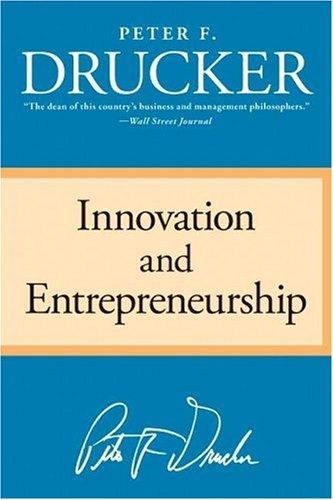
Talk to Innovation and Entrepreneurship like its author wrote you back.
Get the ideas that fit your life — not generic summaries.
- Chat with the book
- Audiobook-style main ideas
- Adapts to your life and goals
- Helps you take action
Innovation and Entrepreneurship, in detail
Innovation and Entrepreneurship is Drucker's systematic treatment of a subject that, in 1985, most people still regarded as the province of lone geniuses and lucky accidents. Drucker rejects that picture entirely. For him, innovation is a discipline — a practice that can be analyzed, learned, and managed just as rigorously as accounting or operations.
The book's first half catalogs seven sources of innovative opportunity. Some are internal to a business or industry: unexpected successes or failures, incongruities between what is and what ought to be, process weaknesses, and changes in market or industry structure. Others come from the outside: demographic shifts, changes in perception, and new knowledge. Drucker's argument is that systematically monitoring these sources, rather than waiting for inspiration, is how most successful innovations actually originate. The case studies are drawn from manufacturing, services, hospitals, and government — a breadth that prevents the analysis from feeling narrowly applicable.
The second half turns to entrepreneurial strategy. Drucker describes four basic approaches: being fastest to exploit a new opportunity (the "fustest with the mostest"), targeting overlooked or underserved niches, changing the economic characteristics of a product or market, and converting a market by redefining value. He is particularly interesting on the management challenges of entrepreneurial ventures — why innovative organizations need to be structured differently, why separating an entrepreneurial unit from an established operation is often necessary, and why many innovations fail not because the idea was wrong but because the organization handling it was wrong for the task.
The book rewards close reading more than it rewards skimming. Drucker writes precisely, and the density of the argument means that a concept introduced in chapter two reappears with new weight in chapter nine. For readers familiar with Drucker's other work, this sits comfortably alongside The Effective Executive and Managing for Results as a practical complement rather than a theoretical exercise. For first-time readers, it can feel dry in places, but the frameworks tend to stick.
The big ideas
- 1.
Innovation is a discipline, not a talent. Systematic scanning of seven specific sources of opportunity produces more innovation than waiting for inspiration.
- 2.
Unexpected success is the most neglected source of innovation. Organizations routinely ignore or dismiss results that don't fit their assumptions.
- 3.
Incongruity — a gap between what is and what ought to be — signals that an assumption underlying the business is wrong and an opportunity exists.
