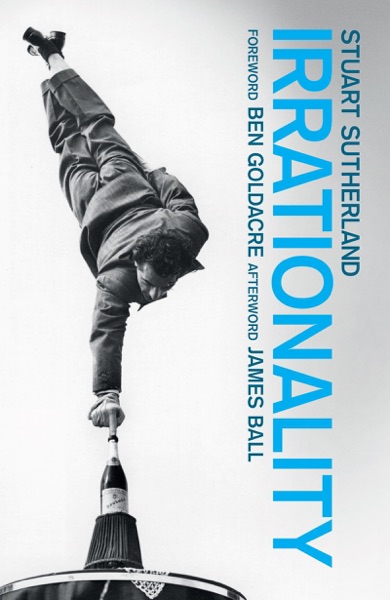
Talk to Irrationality like its author wrote you back.
Get the ideas that fit your life — not generic summaries.
- Chat with the book
- Audiobook-style main ideas
- Adapts to your life and goals
- Helps you take action
Irrationality, in detail
Irrationality is Stuart Sutherland's rigorous and often mordant survey of the ways human beings consistently fail to reason well. Published in 1992, before Daniel Kahneman's Thinking, Fast and Slow made cognitive bias a mainstream topic, the book drew on decades of experimental psychology to document the gap between how people think they make decisions and how they actually do. Sutherland, a professor of experimental psychology at the University of Sussex, wrote the book for general readers and brought to it both scholarly exactness and a dry wit that makes the failures of human reasoning feel both dismaying and occasionally comic.
The book covers a wide range of cognitive failures: the misuse of statistics (people persistently misunderstand base rates, conditional probability, and sample sizes), the influence of availability on judgment (we estimate the frequency of causes of death by how easily examples come to mind, not by how common they actually are), obedience to authority even when it produces clearly wrong outcomes, and the tendency to form and maintain beliefs on inadequate evidence. Sutherland documents each failure with experimental evidence, from Milgram's obedience studies to Kahneman and Tversky's work on heuristics and biases.
What distinguishes Irrationality from lighter treatments of the same material is its insistence on quantifying error and its refusal to offer easy remedies. Sutherland is honest that knowing about a bias does not reliably reduce it. People who have studied the conjunction fallacy still commit it. Doctors who know that base rates matter still ignore them in clinical judgment. The book is not a self-help guide — it is a clear-eyed account of how systematically and predictably human cognition goes wrong, and an argument that this matters enormously in medicine, policy, law, and everyday life.
Some of the specific research Sutherland cites has been updated or challenged in the decades since publication — the replication crisis in psychology has refined our understanding of several classic findings. But the core catalog of biases and the underlying argument remain sound. Irrationality is one of the most intellectually honest popular psychology books written, and it reads with a clarity that later books on the subject often lack.
The big ideas
- 1.
Cognitive biases are not quirks. They are systematic, predictable failures of reasoning that persist even when people know about them and are trying to think carefully.
- 2.
People are very bad at using statistical information. Base rates, conditional probability, and sample sizes are routinely misunderstood even by trained professionals in their own domains.
- 3.
The availability heuristic causes people to judge frequency and probability by how easily examples come to mind, producing systematic distortions in perceived risk.
