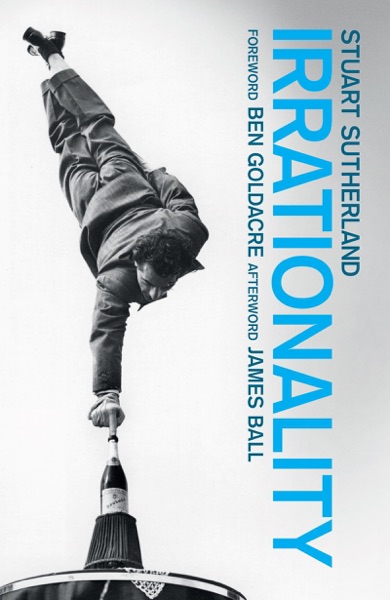
Irrationality by Stuart Sutherland is a 1992 psychology book about cognitive bias, decision-making, rationality. Cognitive biases are not quirks. They are systematic, predictable failures of reasoning that persist even when people know about them and are trying to think carefully.
Summary
Irrationality is Stuart Sutherland's rigorous and often mordant survey of the ways human beings consistently fail to reason well. Published in 1992, before Daniel Kahneman's Thinking, Fast and Slow made cognitive bias a mainstream topic, the book drew on decades of experimental psychology to document the gap between how people think they make decisions and how they actually do. Sutherland, a professor of experimental psychology at the University of Sussex, wrote the book for general readers and brought to it both scholarly exactness and a dry wit that makes the failures of human reasoning feel both dismaying and occasionally comic.
The book covers a wide range of cognitive failures: the misuse of statistics (people persistently misunderstand base rates, conditional probability, and sample sizes), the influence of availability on judgment (we estimate the frequency of causes of death by how easily examples come to mind, not by how common they actually are), obedience to authority even when it produces clearly wrong outcomes, and the tendency to form and maintain beliefs on inadequate evidence. Sutherland documents each failure with experimental evidence, from Milgram's obedience studies to Kahneman and Tversky's work on heuristics and biases.
What distinguishes Irrationality from lighter treatments of the same material is its insistence on quantifying error and its refusal to offer easy remedies. Sutherland is honest that knowing about a bias does not reliably reduce it. People who have studied the conjunction fallacy still commit it. Doctors who know that base rates matter still ignore them in clinical judgment. The book is not a self-help guide — it is a clear-eyed account of how systematically and predictably human cognition goes wrong, and an argument that this matters enormously in medicine, policy, law, and everyday life.
Some of the specific research Sutherland cites has been updated or challenged in the decades since publication — the replication crisis in psychology has refined our understanding of several classic findings. But the core catalog of biases and the underlying argument remain sound. Irrationality is one of the most intellectually honest popular psychology books written, and it reads with a clarity that later books on the subject often lack.
Talk to Irrationality like its author wrote you back.
Get the ideas that fit your life — not generic summaries.
- Chat with the book
- Audiobook-style main ideas
- Adapts to your life and goals
- Helps you take action
Key takeaways
- 1.
Cognitive biases are not quirks. They are systematic, predictable failures of reasoning that persist even when people know about them and are trying to think carefully.
- 2.
People are very bad at using statistical information. Base rates, conditional probability, and sample sizes are routinely misunderstood even by trained professionals in their own domains.
- 3.
The availability heuristic causes people to judge frequency and probability by how easily examples come to mind, producing systematic distortions in perceived risk.
- 4.
Milgram's obedience experiments, and their many replications and variations, show that people are far more willing to follow authority than their self-predictions suggest.
- 5.
Confirmation bias is among the most robust findings: people actively seek evidence that confirms existing beliefs and discount or ignore evidence that challenges them.
- 6.
The sunk cost fallacy — continuing to invest in a failing project because of prior investment — affects individuals, organizations, and governments with remarkable consistency.
- 7.
Knowing about a bias does not reliably reduce it. This is the most uncomfortable finding in the book, and the one most other popular treatments underplay.
- 8.
Irrationality has large social consequences: in medicine it costs lives, in law it produces injustice, in organizations it compounds poor decisions over time.
Discussion questions
Use these on your own, with a book club, or as chat starters in Superbook. Book club version, ready to copy or print →
- 1.
Sutherland argues that knowing about cognitive biases does not reliably help you avoid them. Does this match your experience of trying to think more carefully?
- 2.
The availability heuristic distorts our sense of which risks are large. Which risks do you personally overestimate because of vivid news coverage, and which might you underestimate?
- 3.
Milgram's obedience findings disturbed the postwar psychological world. How do they apply to authority structures in organizations, families, or institutions you know?
- 4.
Sutherland is scathing about the irrationality of doctors and medical judgment. Has this finding become more or less relevant as evidence-based medicine has developed?
- 5.
The sunk cost fallacy is one of the most economically costly biases. Can you identify a decision in your professional or personal life where you continued largely because of past investment?
- 6.
Confirmation bias is deeply tied to identity. At what point does holding a view firmly become irrational rather than appropriately confident?
- 7.
Sutherland wrote Irrationality before social media, algorithmic news feeds, and the attention economy. How do contemporary information environments amplify the failures he describes?
- 8.
The book implicitly argues that better policy and institutional design should compensate for individual cognitive failure. What are the limits of that approach?
- 9.
Why do you think books like Thinking, Fast and Slow became much more famous than Irrationality, which anticipated many of the same arguments and did so more honestly about the limits of self-correction?
- 10.
Sutherland includes a chapter on how irrationality affects his own life, giving personal examples. Does that honesty make the argument more credible, or does it undermine his authority as an analyst?
- 11.
Which cognitive failure described in the book do you most recognize in yourself, and what circumstances make it most likely to occur?
Themes
Frequently asked questions
-
How does Irrationality compare to Thinking, Fast and Slow?
Both cover cognitive biases, but Sutherland's book is narrower, blunter, and more pessimistic about the possibilities of self-correction. Kahneman is a more generous narrator; Sutherland is more clinical. Irrationality predates Thinking, Fast and Slow by nearly twenty years and is in some ways more honest about what the research actually shows.
-
Is Irrationality worth reading in 2026?
Yes, with the caveat that some specific experiments Sutherland cites have been challenged by the replication crisis. The core catalog of biases and the overall argument hold. It reads as a more rigorous and less comfortable treatment than most modern popular psychology books.
-
What is Irrationality's main argument?
That human beings systematically and predictably fail to reason well across a wide range of domains, that these failures are robust against simple awareness of them, and that they have large consequences in medicine, law, politics, and everyday life.
-
Who should read Irrationality?
Anyone interested in how human judgment actually works, especially readers in medicine, law, policy, management, or any other field where systematic reasoning errors carry real costs. It is also a good corrective for readers who finished a lighter bias book feeling they now had the tools to think better.
-
Is the book dated?
The research framework is from the 1970s–1990s, and some specific findings have been revised. But the main biases — availability, confirmation, obedience, base rate neglect, sunk costs — have been robustly replicated. The prose is lucid in a way that has aged better than many more recent books in the same genre.
Similar books
Thinking, Fast and Slow
Daniel Kahneman
Predictably Irrational
Dan Ariely
Blink: The Power of Thinking Without Thinking
Malcolm Gladwell
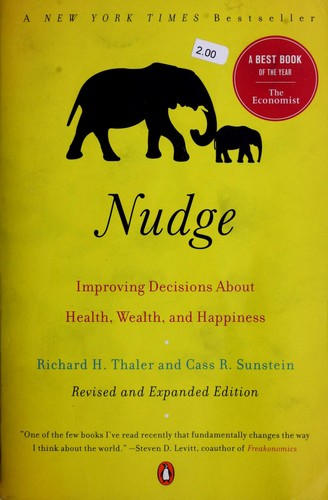
Nudge: Improving Decisions About Health, Wealth, and Happiness
Richard H. Thaler and Cass R. Sunstein
