Talk to It Doesn't Have to Be Crazy at Work like its author wrote you back.
Get the ideas that fit your life — not generic summaries.
- Chat with the book
- Audiobook-style main ideas
- Adapts to your life and goals
- Helps you take action
It Doesn't Have to Be Crazy at Work, in detail
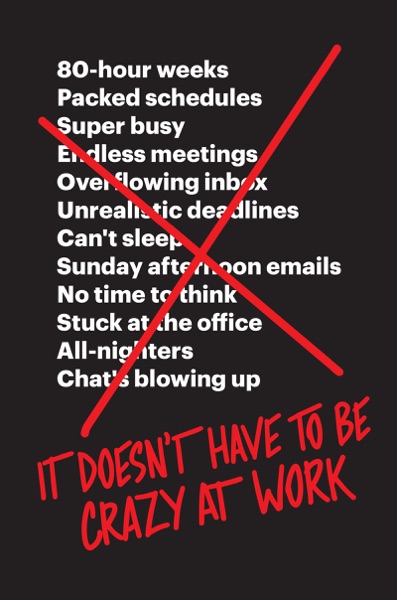
It Doesn't Have to Be Crazy at Work is a direct challenge to the mythology of startup hustle — the idea that long hours, constant urgency, and full-company stress are signs of ambition rather than poor management. Jason Fried and DHH argue from Basecamp's two decades of experience that calm is not the absence of ambition but the product of good decisions: fewer meetings, smaller teams, explicit protections for uninterrupted work, and a refusal to let aspirational growth targets become everyone's emotional burden.
The book is structured as a series of short, punchy essays — some only a page long — each targeting a specific management habit or business culture norm. They take aim at the open-plan office, the expectation of instant reply, growth-at-all-costs thinking, real deadlines versus fake urgency, and the performance of busyness. The writing is confident and sometimes provocative, not hedged by caveats about applicability. Fried and DHH are describing what they do at Basecamp and making the case that other companies should consider it.
Several ideas stand out. The concept of the "Good Enough" goal — setting scope to fit the time, not the other way around — is a direct challenge to how most companies define success. The distinction between "at-will" availability and protected deep-work time maps onto Cal Newport's arguments but comes from an operator rather than an academic. And the repeated emphasis on treating employees like adults — no hidden agendas, no surveillance, clear expectations, real autonomy — runs counter to how most large organizations operate.
The book's weakness is that it's easier to practice these principles as a founder with ownership and control. The Ballé "calm company" philosophy is most naturally implemented top-down, and the book offers limited guidance for managers working inside organizations they don't control. But as a statement of values and a set of concrete practices for anyone with enough authority to try them, it's more actionable than most management writing. The shortness is a feature: it delivers its argument without padding.
The big ideas
- 1.
Busyness is not a badge of honor. A company that is constantly in crisis mode is usually suffering from poor planning, poor scoping, or poor prioritization — not from ambition.
- 2.
Protecting uninterrupted work time is a management responsibility, not just a personal discipline. Open calendars and open chat are productivity taxes on everyone.
- 3.
Set scope to fit the time, not deadlines to fit the scope. Real deadlines are fixed; the variable is what gets done within them.
