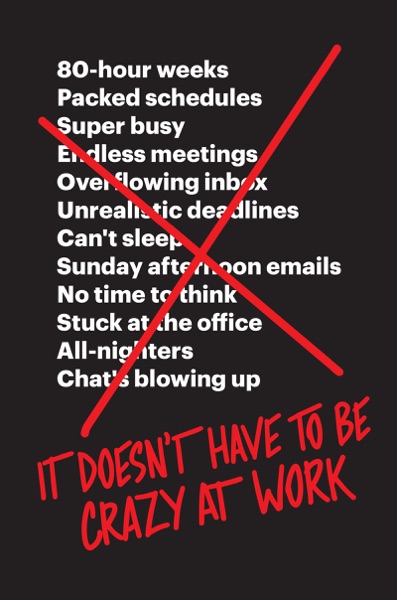
It Doesn't Have to Be Crazy at Work by Jason Fried and David Heinemeier Hansson is a 2018 business book about organizational culture, work-life balance, management. Busyness is not a badge of honor. A company that is constantly in crisis mode is usually suffering from poor planning, poor scoping, or poor prioritization — not from ambition.
Summary
It Doesn't Have to Be Crazy at Work is a direct challenge to the mythology of startup hustle — the idea that long hours, constant urgency, and full-company stress are signs of ambition rather than poor management. Jason Fried and DHH argue from Basecamp's two decades of experience that calm is not the absence of ambition but the product of good decisions: fewer meetings, smaller teams, explicit protections for uninterrupted work, and a refusal to let aspirational growth targets become everyone's emotional burden.
The book is structured as a series of short, punchy essays — some only a page long — each targeting a specific management habit or business culture norm. They take aim at the open-plan office, the expectation of instant reply, growth-at-all-costs thinking, real deadlines versus fake urgency, and the performance of busyness. The writing is confident and sometimes provocative, not hedged by caveats about applicability. Fried and DHH are describing what they do at Basecamp and making the case that other companies should consider it.
Several ideas stand out. The concept of the "Good Enough" goal — setting scope to fit the time, not the other way around — is a direct challenge to how most companies define success. The distinction between "at-will" availability and protected deep-work time maps onto Cal Newport's arguments but comes from an operator rather than an academic. And the repeated emphasis on treating employees like adults — no hidden agendas, no surveillance, clear expectations, real autonomy — runs counter to how most large organizations operate.
The book's weakness is that it's easier to practice these principles as a founder with ownership and control. The Ballé "calm company" philosophy is most naturally implemented top-down, and the book offers limited guidance for managers working inside organizations they don't control. But as a statement of values and a set of concrete practices for anyone with enough authority to try them, it's more actionable than most management writing. The shortness is a feature: it delivers its argument without padding.
Talk to It Doesn't Have to Be Crazy at Work like its author wrote you back.
Get the ideas that fit your life — not generic summaries.
- Chat with the book
- Audiobook-style main ideas
- Adapts to your life and goals
- Helps you take action
Key takeaways
- 1.
Busyness is not a badge of honor. A company that is constantly in crisis mode is usually suffering from poor planning, poor scoping, or poor prioritization — not from ambition.
- 2.
Protecting uninterrupted work time is a management responsibility, not just a personal discipline. Open calendars and open chat are productivity taxes on everyone.
- 3.
Set scope to fit the time, not deadlines to fit the scope. Real deadlines are fixed; the variable is what gets done within them.
- 4.
The expectation of instant reply creates a culture of interruption. Most things can wait hours. Almost nothing requires a response in minutes.
- 5.
Real autonomy means trusting people to do their work without surveillance, not checking in constantly to verify that they are checking in.
- 6.
Aspirational growth targets that belong to investors should not become the daily emotional weather of every employee in the building.
- 7.
Small teams get more done than large ones, partly because coordination overhead grows faster than headcount.
- 8.
Treating employees like adults means being explicit about decisions, sharing real information, and not hiding difficult facts behind corporate language.
Discussion questions
Use these on your own, with a book club, or as chat starters in Superbook. Book club version, ready to copy or print →
- 1.
Fried and DHH argue that busyness is often a sign of poor management rather than high ambition. What in your organization is genuinely urgent versus performatively so?
- 2.
They protect uninterrupted work time as a structural matter. What would it actually take to create protected deep-work blocks in your current role?
- 3.
The book argues for setting scope to fit deadlines rather than setting deadlines to fit scope. How do projects in your organization typically handle that tradeoff?
- 4.
What assumptions does your organization make about availability — response times, meeting attendance, being online — that have never been examined or explicitly chosen?
- 5.
The authors say company growth targets shouldn't become everyone's daily emotional burden. Do employees in your organization carry goals that belong to investors? What effect does that have?
- 6.
Small teams, they argue, outperform large ones because coordination overhead grows faster than output. Where in your experience has that been true or false?
- 7.
The book is written by founders who control their company. How much of its advice is available to managers who don't have that authority?
- 8.
Fried and DHH are explicit about Basecamp's policies and reasoning with employees. How does the transparency in your organization compare to the standard they describe?
- 9.
They argue against surveillance of remote workers. What's the actual problem that monitoring tools are supposed to solve, and does monitoring solve it?
- 10.
What does 'treating employees like adults' mean concretely to you? Where does your organization fall short of that standard?
- 11.
The book takes strong positions and doesn't hedge them. Which of its claims do you find most compelling and which feels most inapplicable to your context?
- 12.
If you could implement one idea from this book starting next week, which would it be, and what would stop you?
Themes
Frequently asked questions
-
Is It Doesn't Have to Be Crazy at Work worth reading?
Yes, especially for founders, executives, and managers with enough authority to act on the ideas. The book is short, direct, and unusually honest about what calm company culture actually requires. Readers without organizational authority will find it inspiring but may feel frustrated by how much depends on leadership commitment.
-
What is the main argument of this book?
That constant urgency, overwork, and busyness are management failures, not signs of ambition. Fried and DHH argue that calm is achievable — through smaller teams, protected work time, scoped goals, and cultures built on trust rather than surveillance.
-
How does this compare to Rework by the same authors?
Rework is broader: it covers how to start and run a simpler business from the ground up. It Doesn't Have to Be Crazy at Work focuses more narrowly on culture and day-to-day management practices. The two books share a philosophy, but this one is more applicable to managers in existing organizations.
-
Who should read It Doesn't Have to Be Crazy at Work?
Founders, team leads, and managers frustrated by the dysfunction they see in how their organization works — and who have enough authority to start changing it. It's also a useful read for anyone who wants language for why hustle culture is counterproductive.
-
How long does it take to read this book?
About three hours. The chapters are very short — many are a single page — so it reads almost like a collection of op-eds. You can finish it in one sitting or work through it in short sessions.