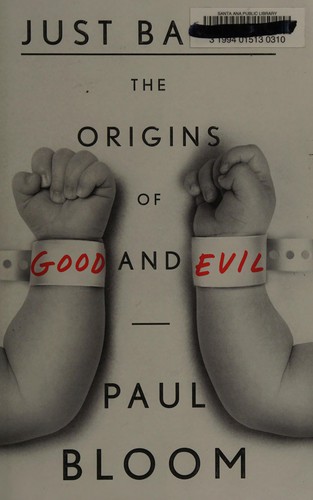
Talk to Just Babies: The Origins of Good and Evil like its author wrote you back.
Get the ideas that fit your life — not generic summaries.
- Chat with the book
- Audiobook-style main ideas
- Adapts to your life and goals
- Helps you take action
Just Babies: The Origins of Good and Evil, in detail
Paul Bloom's central question is how much morality is innate versus learned. Using research from his Yale infant cognition lab and from developmental psychology more broadly, Just Babies argues that babies come into the world with a surprisingly rich set of moral intuitions: a preference for helpful over harmful agents, a rudimentary sense of fairness, some capacity for empathy, and the beginnings of in-group/out-group discrimination. The moral life doesn't start from a blank slate.
The evidence is striking. Infants as young as six months prefer puppets who help others over those who hinder them. They show upset at unequal distributions of resources. They respond to the distress of others with something that looks behaviorally like empathy. This work challenges both the Hobbes view (humans are naturally selfish) and the Rousseau view (humans are naturally good until corrupted by civilization). The more accurate picture, Bloom argues, is that humans are naturally something in between: capable of genuine concern for others but only within a limited circle, prone to fairness but only in ways that often favor themselves, empathic but selective about whose suffering actually registers.
The bulk of the book is an account of what the innate moral kit contains, what it conspicuously lacks, and how culture, reason, and deliberate moral effort extend it. The innate kit gets us to basic prosocial behavior toward people we recognize as similar. What it doesn't get us to is concern for distant strangers, the willingness to extend fairness to outgroups, or the capacity to curb tribalism. Those extensions, Bloom argues, require reason — which is why he is skeptical of empathy as the primary driver of moral progress.
Bloom writes with characteristic clarity and wit, and the infant cognition research makes for genuinely surprising reading. The book is more descriptive than prescriptive — it doesn't tell you how to raise a moral child or build a more ethical society in any systematic way. But as a diagnosis of where human moral psychology starts and what it can and cannot do on its own, it is one of the more honest books in this literature.
The big ideas
- 1.
Infants have a genuine moral sense. By six months, babies prefer agents who help others over those who hinder them, suggesting moral evaluation precedes language and explicit teaching.
- 2.
The innate moral kit is limited by scope. We are naturally more prosocial toward familiar, similar people and instinctively more suspicious of the unfamiliar or different.
- 3.
Fairness intuitions appear early, but they are not impartial. Infants and children show a strong preference for equal distributions, but in practice often interpret fairness in ways that favor their own group.
