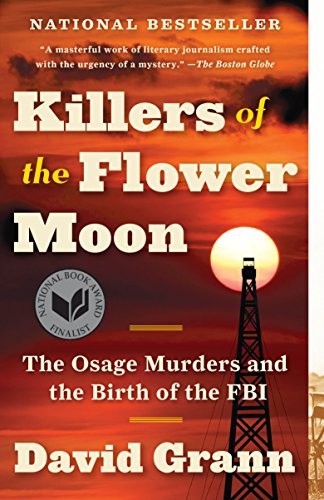
Talk to Killers of the Flower Moon like its author wrote you back.
Get the ideas that fit your life — not generic summaries.
- Chat with the book
- Audiobook-style main ideas
- Adapts to your life and goals
- Helps you take action
Killers of the Flower Moon, in detail
In the 1920s, members of the Osage Nation in northeastern Oklahoma were being murdered. The Osage had become fabulously wealthy after oil was discovered beneath their reservation, and that wealth made them targets. By conservative estimates, dozens of Osage were killed over roughly a decade. Families were poisoned, shot, and blown up. Lawyers and guardians appointed to manage Osage finances stole from them systematically. The deaths were barely investigated and rarely prosecuted. David Grann's book reconstructs this period from court records, family papers, and decades of archival research, asking not only who committed the crimes but how an entire community could be plundered in plain sight.
The investigation that finally brought some accountability became one of the first major cases for the Bureau of Investigation, the predecessor to the FBI. J. Edgar Hoover, newly placed in charge and desperate to prove the agency was more than a patronage operation, sent a young agent named Tom White to Oklahoma. White's approach was methodical and unglamorous: cultivating informants, earning the trust of Osage witnesses, slowly assembling a case that the local law had refused to build. Grann traces White's investigation with the pacing of a thriller, though the real story keeps complicating the clean narrative of a federal rescuer arriving to set things right.
The figure who anchors the book is William Hale, a rancher and self-styled "King of the Osage Hills" who spent years building a reputation as a friend to the Osage while orchestrating their murders for inheritance money. Hale's ability to present himself as a benefactor while running a murder conspiracy is the psychological center of the book. Grann is measured about what this reveals — not a single monster but a structure in which white settlers, local officials, and federal indifference all participated in or enabled what he frames as a systematic campaign of killing.
The final section changes register. Grann discovered, through his own reporting, that the FBI's successful prosecution of a handful of men barely scratched the surface. The death toll was likely far higher than official counts, and most killers were never charged. This pivot complicates the story Grann thought he was telling — and the story the FBI has told about itself — in ways the reader feels as a slow deflation. The book ends not with resolution but with a reckoning that the Osage themselves have had to carry largely alone.
The big ideas
- 1.
The Osage murders were not a crime wave but an organized campaign. William Hale and his associates targeted specific families to acquire headrights — the inherited rights to Osage oil income.
- 2.
The "Indian guardian" system, which required many Osage to have white-appointed financial overseers, was not incidental to the killings. It was part of the same structure of dispossession.
- 3.
The early Bureau of Investigation lacked both legitimacy and competence. The Osage case was in part an institutional audition for the agency that would become the FBI, with Hoover shaping the story to serve that purpose.
