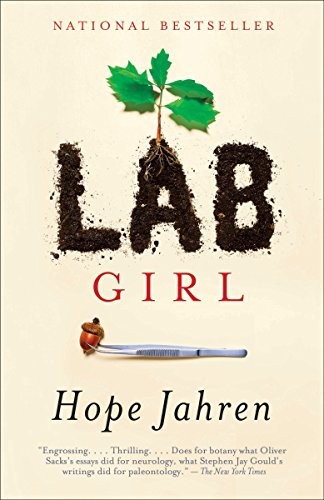
Talk to Lab Girl like its author wrote you back.
Get the ideas that fit your life — not generic summaries.
- Chat with the book
- Audiobook-style main ideas
- Adapts to your life and goals
- Helps you take action
Lab Girl, in detail
Lab Girl is Hope Jahren's memoir of becoming a scientist, told alongside a parallel account of plant biology that is one of the most original structural decisions in recent nonfiction. The book alternates between chapters of autobiography and short botanical essays — on how a seed decides to germinate, how a tree stores water, how roots navigate soil — that are not analogies or metaphors but genuine science writing, precise and accessible, about the organisms Jahren has spent her career studying.
The autobiography follows Jahren from childhood in rural Minnesota, where her father was a community college science teacher who taught her to inhabit the lab as a second home, through graduate school, postdoctoral positions, and three different faculty jobs, including years spent at the University of Hawaii. It is an honest account of what an academic science career actually looks like: the grant cycles, the equipment failures, the institutional politics, the years of doing important work in circumstances of near-poverty.
The book's emotional center is Jahren's friendship and professional partnership with Bill Rye, a man she met in graduate school who has been her lab manager for decades. The relationship is neither romantic nor simple — it is a professional partnership of unusual intensity, built on shared obsession and mutual dependence, and Jahren writes about it with more honesty than most memoir manages about friendship.
Jahren also writes about mental illness. She was diagnosed with bipolar disorder during graduate school and covers her first major manic episode and subsequent hospitalization without softening the experience. The connection between her mental state and her scientific drive is not made explicit, but the juxtaposition is deliberate and leaves the reader to draw their own conclusions. Lab Girl is ultimately a book about what it costs to care deeply about something, and whether that cost is worth it.
The big ideas
- 1.
The botanical chapters are genuine science, not metaphor — Jahren uses them to teach the reader about plant biology while advancing the book's emotional argument about growth, persistence, and care.
- 2.
An academic science career involves years of financial instability, uncertain employment, and constant competition for funding that the popular image of the scientist rarely shows.
- 3.
Jahren's partnership with Bill Rye is central to the memoir — a long-term professional friendship that the book argues is as formative as any romantic relationship.
