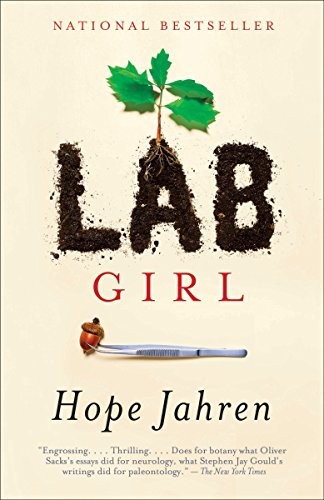
Lab Girl by Hope Jahren is a 2016 memoir book about science, identity, friendship. The botanical chapters are genuine science, not metaphor — Jahren uses them to teach the reader about plant biology while advancing the book's emotional argument about growth, persistence, and care.
Summary
Lab Girl is Hope Jahren's memoir of becoming a scientist, told alongside a parallel account of plant biology that is one of the most original structural decisions in recent nonfiction. The book alternates between chapters of autobiography and short botanical essays — on how a seed decides to germinate, how a tree stores water, how roots navigate soil — that are not analogies or metaphors but genuine science writing, precise and accessible, about the organisms Jahren has spent her career studying.
The autobiography follows Jahren from childhood in rural Minnesota, where her father was a community college science teacher who taught her to inhabit the lab as a second home, through graduate school, postdoctoral positions, and three different faculty jobs, including years spent at the University of Hawaii. It is an honest account of what an academic science career actually looks like: the grant cycles, the equipment failures, the institutional politics, the years of doing important work in circumstances of near-poverty.
The book's emotional center is Jahren's friendship and professional partnership with Bill Rye, a man she met in graduate school who has been her lab manager for decades. The relationship is neither romantic nor simple — it is a professional partnership of unusual intensity, built on shared obsession and mutual dependence, and Jahren writes about it with more honesty than most memoir manages about friendship.
Jahren also writes about mental illness. She was diagnosed with bipolar disorder during graduate school and covers her first major manic episode and subsequent hospitalization without softening the experience. The connection between her mental state and her scientific drive is not made explicit, but the juxtaposition is deliberate and leaves the reader to draw their own conclusions. Lab Girl is ultimately a book about what it costs to care deeply about something, and whether that cost is worth it.
Talk to Lab Girl like its author wrote you back.
Get the ideas that fit your life — not generic summaries.
- Chat with the book
- Audiobook-style main ideas
- Adapts to your life and goals
- Helps you take action
Key takeaways
- 1.
The botanical chapters are genuine science, not metaphor — Jahren uses them to teach the reader about plant biology while advancing the book's emotional argument about growth, persistence, and care.
- 2.
An academic science career involves years of financial instability, uncertain employment, and constant competition for funding that the popular image of the scientist rarely shows.
- 3.
Jahren's partnership with Bill Rye is central to the memoir — a long-term professional friendship that the book argues is as formative as any romantic relationship.
- 4.
Mental illness, particularly bipolar disorder, runs through the book as both subject and context for understanding Jahren's intensity and her relationship to her work.
- 5.
Women in science face specific institutional pressures that Jahren documents without making them the book's entire subject.
- 6.
The lab itself — the physical space of doing science — is treated by Jahren as a kind of home, a place of belonging she worked to create and repeatedly had to leave.
- 7.
Jahren's writing about plants is animated by genuine love; the science is not illustrative but primary, and readers leave the book knowing more about plant biology than they expected.
- 8.
The book implicitly argues that caring about something fully — a plant, a friendship, a piece of research — is its own form of meaning, regardless of external recognition.
Discussion questions
Use these on your own, with a book club, or as chat starters in Superbook. Book club version, ready to copy or print →
- 1.
The book alternates between autobiography and plant biology. Did that structure work for you? Which sections drew you in more, and why?
- 2.
Jahren describes her relationship with Bill Rye as the most important of her adult life. What makes a professional partnership that intense, and have you experienced anything like it?
- 3.
What does Jahren's account of academic science suggest about the relationship between institutional structures and the people who work within them?
- 4.
She covers her bipolar diagnosis and first manic episode directly. How does that section change your reading of the rest of the book's energy and intensity?
- 5.
Jahren grew up in a community college science lab with her father. What environment in your own childhood gave you access to something you otherwise might not have found?
- 6.
The botanical passages teach you real science. Did you find yourself reading them differently from the memoir sections — more analytically, or with less emotional investment?
- 7.
Jahren is honest about the financial precariousness of her early career. How does that account compare with how academic science is popularly imagined?
- 8.
What does the book say, implicitly or explicitly, about being a woman in academic science? Does Jahren seem to want that dimension of the story foregrounded or kept in the background?
- 9.
Which plant in the botanical sections did you find most interesting or surprising, and what did learning about it change about how you see the natural world?
- 10.
Jahren returns to images of the lab as home throughout the book. What does it mean to create belonging in a workplace rather than a domestic space?
- 11.
The memoir ends with Jahren's son, born after the main narrative closes. What does that ending say about what the book's years of scientific obsession were leading toward?
- 12.
What is the book arguing about the relationship between scientific knowledge and meaning? Is knowing how a plant works incompatible with finding it beautiful?
Themes
Frequently asked questions
-
What is Lab Girl about?
It is Hope Jahren's memoir of becoming a scientist, told alongside chapters of plant biology. The book covers her childhood, academic career, long friendship with her lab manager Bill Rye, and her diagnosis with bipolar disorder, while also teaching you real science about how plants live.
-
Do you need to be a scientist to enjoy Lab Girl?
No. The botanical chapters are written to be accessible to general readers, and the memoir sections require no scientific background. Several readers with no science interest have described the book as revelatory about both plants and academic life.
-
Is Lab Girl worth reading?
Yes, particularly if you are interested in memoir with structural ambition or in what science actually looks like from the inside. The writing is precise and warm, the friendship with Bill is memorable, and the plant science is genuinely interesting.
-
How long does it take to read?
Around five to six hours. The chapters are short and alternate in register — the botanical essays are denser, the memoir chapters faster. Most readers find the rhythm carries them forward without difficulty.
-
Who should read Lab Girl?
Anyone interested in women in science, in academic careers, in unusual memoir structures, or in the natural world. Also a strong book club choice because the structural device — alternating science and memoir — gives groups something concrete to discuss beyond the personal narrative.
Similar books

The Immortal Life of Henrietta Lacks
Rebecca Skloot
Silent Spring
Rachel Carson
The Emperor of All Maladies: A Biography of Cancer
Siddhartha Mukherjee
Educated: A Memoir
Tara Westover
