Talk to Laws of UX like its author wrote you back.
Get the ideas that fit your life — not generic summaries.
- Chat with the book
- Audiobook-style main ideas
- Adapts to your life and goals
- Helps you take action
What it argues
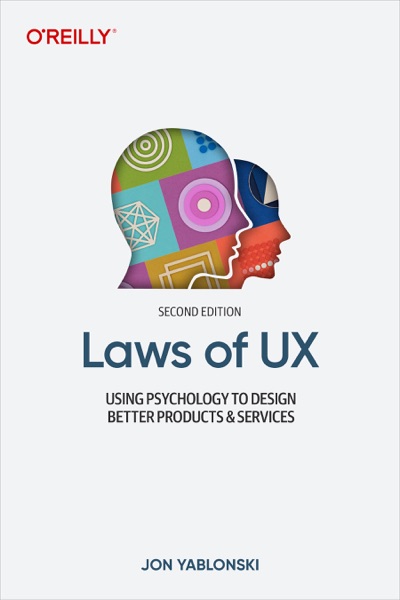
Laws of UX is Jon Yablonski's collection of ten principles drawn from psychology and cognitive science that bear directly on user interface design. Originally a website (lawsofux.com) launched in 2018, the book version published by O'Reilly in 2020 expands each principle with context, examples, and design guidance. It is a short, dense book aimed at practitioners who want to ground their design decisions in human cognitive tendencies rather than taste or convention.
The principles Yablonski covers include Hick's Law (more choices mean slower decisions — relevant to navigation and feature design), Fitts's Law (targets should be sized and positioned proportionally to how often they're used), the Aesthetic-Usability Effect (attractive interfaces are perceived as more usable, sometimes falsely), the Peak-End Rule (users remember the peak moment and the final moment of an experience disproportionately), and the Von Restorff Effect (things that differ from their surroundings are remembered). None of these are original to Yablonski — they come from psychology research spanning decades — but his contribution is to apply them specifically to digital product design and to show, with concrete examples, how violation of each principle produces recognizable failures.
What it gets right
- 1.
Hick's Law: the time to make a decision increases logarithmically with the number of options. Menus, onboarding flows, and feature sets should reduce choices, not maximize them.
- 2.
Fitts's Law: the time to reach a target depends on its distance and size. The most frequently used controls should be the largest and most accessible — a principle violated constantly in mobile design.
- 3.
The Aesthetic-Usability Effect means attractive interfaces are perceived as easier to use even when they aren't. Beauty is not separate from function; it shapes how users evaluate function.
What it covers
Who wrote it
Jon Yablonski is a product designer and design leader based in Michigan. He created the Laws of UX website in 2018 as a resource for designers wanting to apply psychological principles to interface design, and the site attracted a large following in the UX and product design communities. Laws of UX, published by O'Reilly in 2020, is his first book. He has worked in digital product design across automotive, healthcare, and technology sectors, and writes regularly about design practice and ethics. The book has been translated into multiple languages and is widely used in design education programs.
